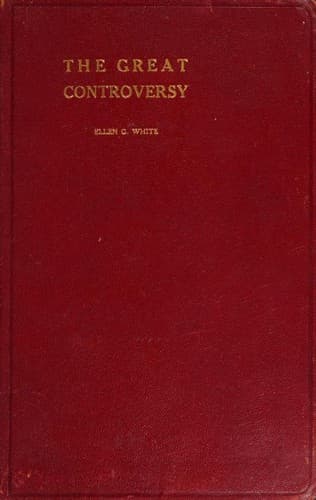
The Great Controversy Between Christ and SatanWhite, Ellen Gould Harmon
ReligionComparative
The Great Controversy Between Christ and Satan
White, Ellen Gould Harmon
Good and evil; Seventh-Day Adventists -- Doctrines; Spiritual direction
Baxter, Flavel, Alleine, and other men of talent, education, and deep
Christian experience, stood up in valiant defense of the faith which was
once delivered to the saints. The work accomplished by these men,
proscribed and outlawed by the rulers of this world, can never perish.
Flavel’s “Fountain of Life” and “Method of Grace” have taught thousands
how to commit the keeping of their souls to Christ. Baxter’s “Reformed
Pastor” has proved a blessing to many who desire a revival of the work of
God, and his “Saints’ Everlasting Rest” has done its work in leading souls
to the “rest that remaineth for the people of God.”
A hundred years later, in a day of great spiritual darkness, Whitefield
and the Wesleys appeared as light-bearers for God. Under the rule of the
established church, the people of England had lapsed into a state of
religious declension hardly to be distinguished from heathenism. Natural
religion was the favorite study of the clergy, and included most of their
theology. The higher classes sneered at piety, and prided themselves on
being above what they called its fanaticism. The lower classes were
grossly ignorant, and abandoned to vice, while the church had no courage
or faith any longer to support the downfallen cause of truth.
The great doctrine of justification by faith, so clearly taught by Luther,
had been almost wholly lost sight of; and the Romish principle of trusting
to good works for salvation, had taken its place. Whitefield and the
Wesleys, who were members of the established church, were sincere seekers
for the favor of God, and this they had been taught was to be secured by a
virtuous life and an observance of the ordinances of religion.
When Charles Wesley at one time fell ill, and anticipated that death was
approaching, he was asked upon what he rested his hope of eternal life.
His answer was, “I have used my best endeavors to serve God.” As the
friend who had put the question seemed not to be fully satisfied with his
answer, Wesley thought, “What! are not my endeavors a sufficient ground of
hope? Would he rob me of my endeavors? I have nothing else to trust
to.”(369) Such was the dense darkness that had settled down on the church,
hiding the atonement, robbing Christ of His glory, and turning the minds
of men from their only hope of salvation,—the blood of the crucified
Redeemer.
Public-domain text, read in full here on John Shaqi.
Reviews
Reviews
No reviews yet
Be the first to share your thoughts on this work.
Elsewhere in the archive
Join the Discussion
Join the discussion
Sign in to leave a comment or review.
Sign InorCreate an account