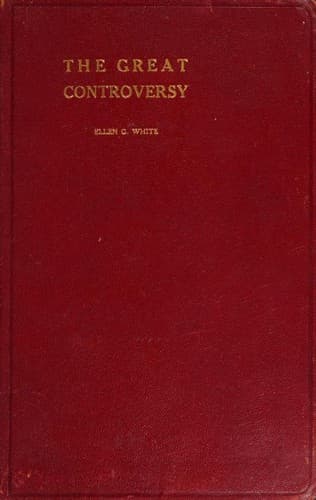
The Great Controversy Between Christ and SatanWhite, Ellen Gould Harmon
ReligionComparative
The Great Controversy Between Christ and Satan
White, Ellen Gould Harmon
Good and evil; Seventh-Day Adventists -- Doctrines; Spiritual direction
“Remember your church covenant, in which you have agreed to walk in all
the ways of the Lord, made or to be made known unto you. Remember your
promise and covenant with God and with one another, to receive whatever
light and truth shall be made known to you from His written word; but
withal, take heed, I beseech you, what you receive for truth, and compare
it and weigh it with other scriptures of truth before you accept it; for
it is not possible the Christian world should come so lately out of such
thick antichristian darkness, and that full perfection of knowledge should
break forth at once.”(437)
It was the desire for liberty of conscience that inspired the Pilgrims to
brave the perils of the long journey across the sea, to endure the
hardships and dangers of the wilderness, and with God’s blessing to lay,
on the shores of America, the foundation of a mighty nation. Yet honest
and God-fearing as they were, the Pilgrims did not yet comprehend the
great principle of religious liberty. The freedom which they sacrificed so
much to secure for themselves, they were not equally ready to grant to
others. “Very few, even of the foremost thinkers and moralists of the
seventeenth century, had any just conception of that grand principle, the
outgrowth of the New Testament, which acknowledges God as the sole judge
of human faith.”(438) The doctrine that God has committed to the church
the right to control the conscience, and to define and punish heresy, is
one of the most deeply rooted of papal errors. While the Reformers
rejected the creed of Rome, they were not entirely free from her spirit of
intolerance. The dense darkness in which, through the long ages of her
rule, popery had enveloped all Christendom, had not even yet been wholly
dissipated. Said one of the leading ministers in the colony of
Massachusetts Bay: “It was toleration that made the world antichristian;
and the church never took harm by the punishment of heretics.”(439) The
regulation was adopted by the colonists, that only church-members should
have a voice in the civil government. A kind of state church was formed,
all the people being required to contribute to the support of the clergy,
and the magistrates being authorized to suppress heresy. Thus the secular
power was in the hands of the church. It was not long before these
measures led to the inevitable result—persecution.
Public-domain text, read in full here on John Shaqi.
Reviews
Reviews
No reviews yet
Be the first to share your thoughts on this work.
Elsewhere in the archive
Join the Discussion
Join the discussion
Sign in to leave a comment or review.
Sign InorCreate an account