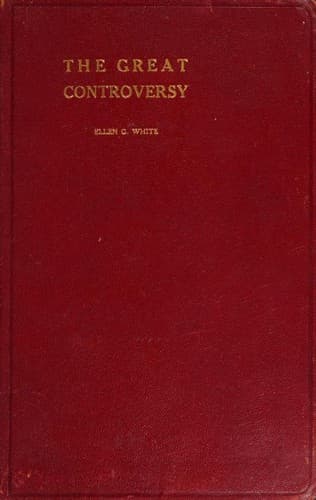
The Great Controversy Between Christ and SatanWhite, Ellen Gould Harmon
ReligionComparative
The Great Controversy Between Christ and Satan
White, Ellen Gould Harmon
Good and evil; Seventh-Day Adventists -- Doctrines; Spiritual direction
With intense interest he studied the books of Daniel and the Revelation,
employing the same principles of interpretation as in the other
scriptures, and found, to his great joy, that the prophetic symbols could
be understood. He saw that the prophecies, so far as they had been
fulfilled, had been fulfilled literally; that all the various figures,
metaphors, parables, similitudes, etc., were either explained in their
immediate connection, or the terms in which they were expressed were
defined in other scriptures, and when thus explained, were to be literally
understood. “I was thus satisfied,” he says, “that the Bible is a system
of revealed truths, so clearly and simply given that the wayfaring man,
though a fool, need not err therein.”(519) Link after link of the chain of
truth rewarded his efforts, as step by step he traced down the great lines
of prophecy. Angels of heaven were guiding his mind and opening the
Scriptures to his understanding.
Taking the manner in which the prophecies had been fulfilled in the past,
as a criterion by which to judge of the fulfilment of those which were
still future, he became satisfied that the popular view of the spiritual
reign of Christ—a temporal millennium before the end of the world—was not
sustained by the word of God. This doctrine, pointing to a thousand years
of righteousness and peace before the personal coming of the Lord, put far
off the terrors of the day of God. But, pleasing though it may be, it is
contrary to the teachings of Christ and His apostles, who declared that
the wheat and the tares are to grow together until the harvest, the end of
the world;(520) that “evil men and seducers shall wax worse and worse;”
that “in the last days perilous times shall come;”(521) and that the
kingdom of darkness shall continue until the advent of the Lord, and shall
be consumed with the spirit of His mouth, and be destroyed with the
brightness of His coming.(522)
The doctrine of the world’s conversion and the spiritual reign of Christ
was not held by the apostolic church. It was not generally accepted by
Christians until about the beginning of the eighteenth century. Like every
other error, its results were evil. It taught men to look far in the
future for the coming of the Lord, and prevented them from giving heed to
the signs heralding His approach. It induced a feeling of confidence and
security that was not well founded, and led many to neglect the
preparation necessary in order to meet their Lord.
Public-domain text, read in full here on John Shaqi.
Reviews
Reviews
No reviews yet
Be the first to share your thoughts on this work.
Elsewhere in the archive
Join the Discussion
Join the discussion
Sign in to leave a comment or review.
Sign InorCreate an account