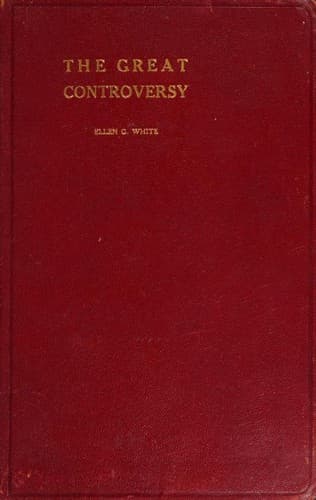
The Great Controversy Between Christ and SatanWhite, Ellen Gould Harmon
ReligionComparative
The Great Controversy Between Christ and Satan
White, Ellen Gould Harmon
Good and evil; Seventh-Day Adventists -- Doctrines; Spiritual direction
But the churches generally did not accept the warning. Their ministers,
who, as “watchmen unto the house of Israel,” should have been the first to
discern the tokens of Jesus’ coming, had failed to learn the truth, either
from the testimony of the prophets or from the signs of the times. As
worldly hopes and ambitions filled the heart, love for God and faith in
His word had grown cold; and when the advent doctrine was presented, it
only aroused their prejudice and unbelief. The fact that the message was,
to a great extent, preached by laymen, was urged as an argument against
it. As of old, the plain testimony of God’s word was met with the inquiry,
“Have any of the rulers or of the Pharisees believed?” And finding how
difficult a task it was to refute the arguments drawn from the prophetic
periods, many discouraged the study of the prophecies, teaching that the
prophetic books were sealed, and were not to be understood. Multitudes,
trusting implicitly to their pastors, refused to listen to the warning;
and others, though convinced of the truth, dared not confess it, lest they
should be “put out of the synagogue.” The message which God had sent for
the testing and purification of the church, revealed all too surely how
great was the number who had set their affections on this world rather
than upon Christ. The ties which bound them to earth were stronger than
the attractions heavenward. They chose to listen to the voice of worldly
wisdom, and turned away from the heart-searching message of truth.
In refusing the warning of the first angel, they rejected the means which
Heaven had provided for their restoration. They spurned the gracious
messenger that would have corrected the evils which separated them from
God, and with greater eagerness they turned to seek the friendship of the
world. Here was the cause of that fearful condition of worldliness,
backsliding, and spiritual death which existed in the churches in 1844.
In Revelation 14, the first angel is followed by a second, proclaiming,
“Babylon is fallen, is fallen, that great city, because she made all
nations drink of the wine of the wrath of her fornication.”(623) The term
“Babylon” is derived from “Babel,” and signifies confusion. It is employed
in Scripture to designate the various forms of false or apostate religion.
In Revelation 17, Babylon is represented as a woman,—a figure which is
used in the Bible as the symbol of a church, a virtuous woman representing
a pure church, a vile woman an apostate church.
Public-domain text, read in full here on John Shaqi.
Reviews
Reviews
No reviews yet
Be the first to share your thoughts on this work.
Elsewhere in the archive
Join the Discussion
Join the discussion
Sign in to leave a comment or review.
Sign InorCreate an account