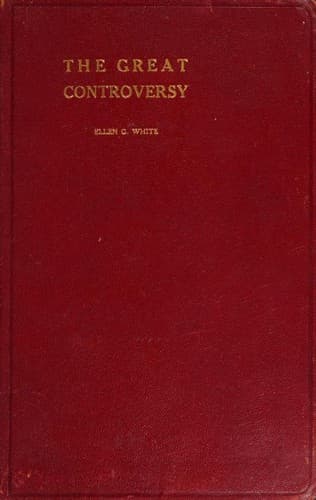
The Great Controversy Between Christ and SatanWhite, Ellen Gould Harmon
ReligionComparative
The Great Controversy Between Christ and Satan
White, Ellen Gould Harmon
Good and evil; Seventh-Day Adventists -- Doctrines; Spiritual direction
The words of Jerome excited astonishment and admiration, even in his
enemies. For a whole year he had been immured in a dungeon, unable to read
or even to see, in great physical suffering and mental anxiety. Yet his
arguments were presented with as much clearness and power as if he had had
undisturbed opportunity for study. He pointed his hearers to the long line
of holy men who had been condemned by unjust judges. In almost every
generation have been those who, while seeking to elevate the people of
their time, have been reproached and cast out, but who in later times have
been shown to be deserving of honor. Christ Himself was condemned as a
malefactor at an unrighteous tribunal.
At his retraction, Jerome had assented to the justice of the sentence
condemning Huss; he now declared his repentance, and bore witness to the
innocence and holiness of the martyr. “I knew him from his childhood,” he
said. “He was a most excellent man, just and holy; he was condemned,
notwithstanding his innocence.... I also—I am ready to die: I will not
recoil before the torments that are prepared for me by my enemies and
false witnesses, who will one day have to render an account of their
impostures before the great God, whom nothing can deceive.”(149)
In self-reproach for his own denial of the truth, Jerome continued: “Of
all the sins that I have committed since my youth, none weigh so heavily
on my mind, and cause me such poignant remorse, as that which I committed
in this fatal place, when I approved of the iniquitous sentence rendered
against Wycliffe, and against the holy martyr, John Huss, my master and my
friend. Yes! I confess it from my heart, and declare with horror that I
disgracefully quailed when, through a dread of death, I condemned their
doctrines. I therefore supplicate ... Almighty God to deign to pardon me
my sins, and this one in particular, the most heinous of all.” Pointing to
his judges, he said firmly: “You condemned Wycliffe and John Huss, not for
having shaken the doctrine of the church, but simply because they branded
with reprobation the scandals proceeding from the clergy,—their pomp,
their pride, and all the vices of the prelates and priests. The things
which they have affirmed, and which are irrefutable, I also think and
declare, like them.”
His words were interrupted. The prelates, trembling with rage, cried out,
“What need is there of further proof? We behold with our own eyes the most
obstinate of heretics!”
Unmoved by the tempest, Jerome exclaimed: “What! do you suppose that I
fear to die? You have held me for a whole year in a frightful dungeon,
more horrible than death itself. You have treated me more cruelly than a
Turk, Jew, or pagan, and my flesh has literally rotted off my bones alive;
and yet I make no complaint, for lamentation ill becomes a man of heart
and spirit; but I cannot but express my astonishment at such great
barbarity toward a Christian.”(150)
Public-domain text, read in full here on John Shaqi.
Reviews
Reviews
No reviews yet
Be the first to share your thoughts on this work.
Elsewhere in the archive
Join the Discussion
Join the discussion
Sign in to leave a comment or review.
Sign InorCreate an account