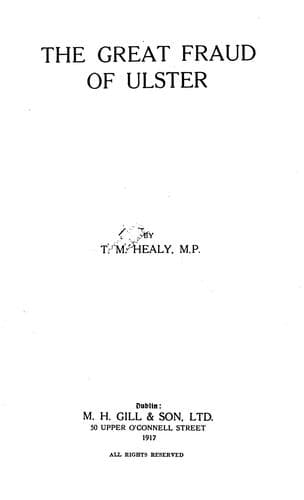
The great fraud of UlsterHealy, T. M. (Timothy Michael)
History
The great fraud of Ulster
Healy, T. M. (Timothy Michael)
Ireland -- History -- 17th century; Ulster (Northern Ireland and Ireland) -- History
The American upheaval was itself preceded by a rebellion amongst the
Ulster Protestants. A close connection can be traced between the
failure of the one outbreak and the success of the other. In July,
1770—only eighty years after the Battle of the Boyne—the offspring of
the Planters in the Counties of Antrim, Down, Derry, and Tyrone rose
in arms. British writers like J. A. Froude and John Wesley, Irish
historians like Lecky and Benn, agree as to the responsibility of the
landlords who provoked the insurrection. Froude links together as
cause and effect the atrocities of the Marquis of Donegall and the
loss of the American Colonies.
He says:—“Sir Arthur Chichester, the great Viceroy of Ireland under
James I., was, of all Englishmen who ever settled in the country,
the most useful to it. His descendant, the Lord Donegall, of whom it
has become necessary to speak, was perhaps the person who inflicted
the greatest injury to it. Sir Arthur had been rewarded for his
services by vast estates in the County Antrim. The fifth Earl and
first Marquis of Donegall, already by the growth of Belfast and the
fruit of other men’s labours, while he was sitting still, enormously
rich, found his income still unequal to his yet more enormous
expenditure. His name is looked for in vain among the nobles who, in
return for high places, were found in the active service of their
country. He was one of those habitual and splendid absentees who
discharged his duties to the God who made him by magnificently doing
as he would with his own. Many of his Antrim leases having fallen
in simultaneously he demanded £100,000 in fines for the renewal of
them. The tenants, all Protestants, offered the interest of the
money in addition to the rent. It could not be. Speculative Belfast
capitalists paid the fine and took the lands over the heads of the
tenants to sub-let.
“Mr. Clotworthy Upton, another great Antrim proprietor, imitated the
example, and at once the whole countryside were driven from their
habitations. Sturdy Scots, who in five generations had reclaimed
Antrim from the wilderness, saw the farms, which they and their
fathers had made valuable, let by auction to the highest bidder; and,
when they refused to submit themselves to robbery, saw them let to
others, and let in many instances to Catholics, who would promise
anything to recover their hold on the soil.
“The most substantial of the expelled tenantry gathered their
effects together and sailed to join their countrymen in the New
World, where the Scotch-Irish became known as the most bitter of the
Secessionists.”
Mr. Froude traces to these evictions the uprise of the “Peep of Day”
and the “Hearts of Steel” conspiracies, and adds:—
Public-domain text, read in full here on John Shaqi.
Reviews
Reviews
No reviews yet
Be the first to share your thoughts on this work.
Elsewhere in the archive
Join the Discussion
Join the discussion
Sign in to leave a comment or review.
Sign InorCreate an account