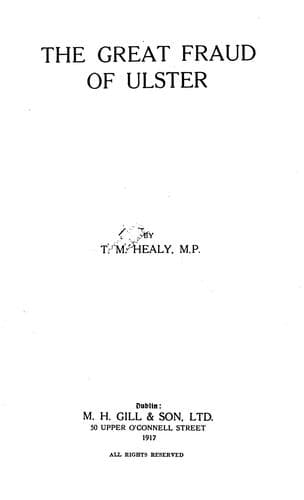
The great fraud of UlsterHealy, T. M. (Timothy Michael)
History
The great fraud of Ulster
Healy, T. M. (Timothy Michael)
Ireland -- History -- 17th century; Ulster (Northern Ireland and Ireland) -- History
In 1755 Lord Massereene’s lease of 1660 expired, and in 1769 the
Lord Donegall of that day began to take thought of his “reversion”
to the fisheries. The claim of the Chichesters had slept for over
a century, and was unknown to the people. Its assertion was beset
with difficulties, for the Irish Parliament and Executive would have
set themselves against any attempt by such an individual to control
Lough Neagh. Several Statutes treated it as both a public highway and
a public fishery. But his plans to capture it were skilfully laid.
The Londoners had, between 1744 and 1760, erected four traps in the
Bann at the Leap of Coleraine near the sea for the capture of salmon.
These necessarily diminished the catch further up, and Lord Donegall,
without impugning their Charter, objected that their mode of fishing
injured his rights in a corner of Lough Neagh. He laid his complaint
of damage in a pool on the Armagh shore, forty miles from the traps,
instead of in the Bann, and singled out as his quarry the lessee of
the unpopular “Irish Society” to serve as defendant. In this way his
grant of 1661 was for the first time brought to the notice of the
public.
In 1781 and 1784 he launched actions, which miscarried, for trespass
to the supposed fishing in Co. Armagh by the erection of the traps.
In 1787 he made a fresh onset, and the third trial began in 1788 at
Armagh, 33 years after the expiration of Lord Massereene’s lease. In
framing his suit he astutely avoided anything which would raise a
question as to the validity of his Patent. Hence he made no claim for
damage to the fishery of the Bann, where the mischief from the traps
would have been sorest, lest, as the Londoners’ Charter included the
entire river, a battle as to title should begin. He rigidly confined
his complaint within Lough Neagh, to which their Charter did not
apply. At the trial, therefore, the only issue was: Did the erection
of the traps injure the supposed fishery in the pool of Lough Neagh
to which the Londoners could make no claim? If he had charged damages
to the Bann he could have had a trial in Antrim, which is bounded by
the river. There, a friendly Sheriff would have composed a jury more
to his liking; but he laid the venue in Armagh, where he was without
local influence, rather than force a conflict with the Londoners
as to his pretensions to the Bann. The motive which inspired these
tactics and its cunning is evident.
Public-domain text, read in full here on John Shaqi.
Reviews
Reviews
No reviews yet
Be the first to share your thoughts on this work.
Elsewhere in the archive
Join the Discussion
Join the discussion
Sign in to leave a comment or review.
Sign InorCreate an account