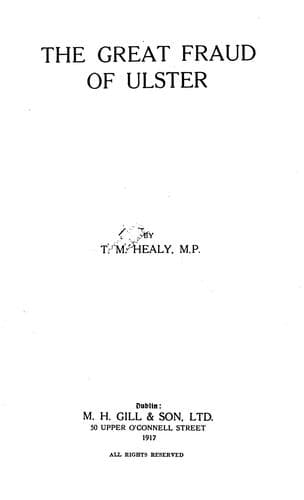
The great fraud of UlsterHealy, T. M. (Timothy Michael)
History
The great fraud of Ulster
Healy, T. M. (Timothy Michael)
Ireland -- History -- 17th century; Ulster (Northern Ireland and Ireland) -- History
By this compromise they acknowledged his ownership of their own
waters, and the long struggle between the City which financed the
Plantation and its adversaries fizzled out in a dismal attornment.
A title, guaranteed to them by the charters and promises of three
Kings and the parchments of Oliver Cromwell, was abandoned for ever.
Holding genuine and undoubted grants, they did homage to the suspect
scrivenery of the freebooters who for three centuries had plotted to
despoil them. What could explain such a nerveless breakdown? No doubt
Fitzgibbon’s bemusement as to the Act of Settlement misled them,
but why was there no one to unravel the mystery of iniquity lurking
behind the deeds of 1661, 1656, 1621, 1611, 1608, 1606, or 1603-4?
In 1872, when they capitulated, the work of the Irish and English
Record Offices had shed much light on the grants and confiscations of
the Stuart and Cromwellian periods. The documents in the Rolls and
Exchequer Offices had been translated, calendared, and indexed. State
papers, inquisitions, and MSS. from a number of libraries had been
published. It was with all these sources of information thrown open
that the Irish Society, having begun their assertion of title, tamely
acknowledged the overlordship of their ancient enemy.
When the richest Corporation in the world, and the Imperial city of
the Empire, could be baffled in such wise, what hope had the natives
in days of yore of retaining their property against the greed of
those who controlled the machinery of Irish government?
CHAPTER XXVII.
TWO GREAT TRIALS.
The acceptance by the Londoners of the parchments of Lord Donegall
was an event of mournful significance for East Ulster. The concern
of the public in it was immediate, for it created a new situation
which affected everyone along the banks of Lough Neagh. When such
powerful opponents confessed the validity of the Donegall grant, and
accepted a lease thereunder, they became almost as much interested in
maintaining it as the owner himself. Before their capitulation nobody
had ventured to dispute the ancient custom by which the public fished
in and trafficked over the Lough. The moment a great Corporation bent
the knee to wrong, an unexpected impulse was given to the spirit of
encroachment. Once they yielded, with what hope could poor men hold
out?
The thought, therefore, struck the Donegall lessee who claimed Lough
Neagh as being embraced in his demise that to turn a thousand free
fishermen into toll-paying serfs would prove a profitable enterprise.
To assert his “rights” he took proceedings to restrain them from
catching salmon in the Lough. For five years this action dragged from
Court to Court, and only ended in the House of Lords in 1878.
Public-domain text, read in full here on John Shaqi.
Reviews
Reviews
No reviews yet
Be the first to share your thoughts on this work.
Elsewhere in the archive
Join the Discussion
Join the discussion
Sign in to leave a comment or review.
Sign InorCreate an account