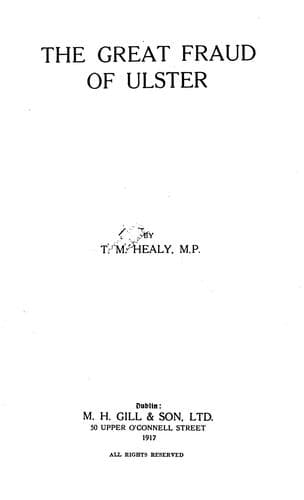
The great fraud of UlsterHealy, T. M. (Timothy Michael)
History
The great fraud of Ulster
Healy, T. M. (Timothy Michael)
Ireland -- History -- 17th century; Ulster (Northern Ireland and Ireland) -- History
3rd. That “the only Inquisitions, Patents, and Grants” relating
to the Lough in the Record Office were those in the list he set
out—swearing he was “satisfied there were no others dealing with the
fisheries in Lough Neagh.”
These propositions, if true, went far to meet the judgment of the
House of Lords in the former trial. Yet, extraordinary to relate,
they were either wholly unfounded or very much astray. Only when
too late did the facts leak out. The archivist’s list was vitally
defective and incomplete, while the Commission was far from being
“practically all illegible.” The earliest Patent was not that of
1606 to Hamilton, but those concocted by Chichester in 1603 and
1604, which as regards Lough Neagh and the Bann were warranted by
no authority from James I. The Patents and King’s Letters of 1603-4
were not mentioned by the archivist, and they formed the key to the
position as defined by the House of Lords.
When Chichester in 1604 appropriated the title of “Admiral of Lough
Neagh” he snatched a life-estate in the fisheries without the King’s
knowledge. Neither Lough Neagh nor the non-tidal Bann then was
claimed by or “in charge” to the Crown. If the existence of these
Patents had been disclosed, and if the King’s Letter of 1603 had not
been withheld, the fact that the fishery grants originated without
Royal approval would have been established.
The Letters throw a piercing searchlight on the problem raised by the
House of Lords, for they prove that James I. nowhere mentions the
fisheries. Their silence, therefore, reveals that the origin of the
grant lay not with the Crown, but in fraud. This fact being shut out
from judicial cognisance, the cardinal principle laid down by the
House of Lords was frustrated—viz., that the existence of Royal title
to make a grant must be lawfully deduced.
To treat the Patent of 1606 as the earliest of the series not merely
got rid of the necessity for coping with the fatal parchments of
1603-4, but enabled the contention to prevail that Hamilton’s Patent
was based on a valid inquisition. For at the “office” at Antrim on
12th July, 1605, a jury was alleged to have found that a pool in
Lough Neagh was owned by the Crown. This verdict was arrived at on
the inquisition held by Parsons, and at the trial in 1908 it assumed
a fundamental importance. The terms of the Commission authorising it
became equally vital, and as to these the archivist swore:—
“The Commission for holding the inquisition is attached to the
original inquisition, and is practically all illegible. The
inquisition deals with the eastern side of Lough Neagh only, and
lands adjoining.”
Public-domain text, read in full here on John Shaqi.
Reviews
Reviews
No reviews yet
Be the first to share your thoughts on this work.
Elsewhere in the archive
Join the Discussion
Join the discussion
Sign in to leave a comment or review.
Sign InorCreate an account