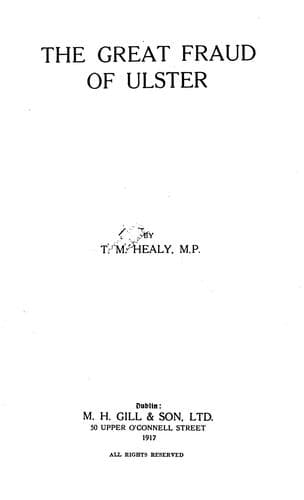
The great fraud of UlsterHealy, T. M. (Timothy Michael)
History
The great fraud of Ulster
Healy, T. M. (Timothy Michael)
Ireland -- History -- 17th century; Ulster (Northern Ireland and Ireland) -- History
Other differences also exposed its falsity. One of the most
extraordinary was the contrast between the “Lease” and the “Memorial”
as to the mode of witnessing Lord Donegall’s signature. Two witnesses
attested the “lease,” whereas the “Memorial” showed there had
been three to the original. The same three persons attested Lord
Donegall’s signature to the “Memorial” itself. Had the case been
reversed, and if the names of three witnesses figured on the “lease”
while only two appeared on the “Memorial,” the absence of a name
from the latter might be explained by carelessness or mischance. No
such excuse could account for the disappearance of a signature from
an “original” and its presence in a secondary document. Only one
conclusion from such a variance seemed possible, yet the plaintiffs
insisted that the “Memorial” was unreliable, and the piebald
parchment genuine.
No Memorial had ever before been discredited in the centuries since
registration was established. The title to millions’ worth of
property, not only in Ireland but in wealthy Middlesex and vast
Yorkshire, depends on their trustworthiness. The manner of their
preparation and lodgment, as a system of verification of the contents
of deeds, is one prescribed by Statute to prevent fraud, or to detect
it if committed. Lord Donegall’s “Memorial” branded the so-called
“original” as a counterfeit. That was the function which the law
assigned to it, and it fulfilled its duty. Still the imputation of
forgery was too rude and uncourtly for the 20th century. A theory of
inadvertence and mistake was preferred. “Forgery” is a hard saying,
and any suggestion to explain it away attracts an honest mind. So the
“Memorial” was held to be inconclusive, and the counterfeit genuine,
by Mr. Justice Ross.
Fortunately for the repute of registration, research brought
afterwards to light collateral proof of its reliability. On the day
Lord Donegall executed the lease in dispute he also gave May a second
lease relating to a quarry. Both were registered on the same day and
by the same officials in Dublin. The “Memorial” of the quarry lease
showed there were three witnesses to Lord Donegall’s signature, and
that these were the same three persons who attested the fishery lease
and its “Memorial.” Thus the witnessing trio were certified to be
the same in the case of two leases and two “Memorials”—whereas the
document relied on by the plaintiffs bore the signatures of only two
witnesses. An independent and collateral registration, therefore,
corroborated the “Memorial” of the fishery lease in a vital respect.
To cast discredit on it in order to bolster up the decrepit Patents
of the Donegalls was an ill tribute to the system on which so much
property rests.
Public-domain text, read in full here on John Shaqi.
Reviews
Reviews
No reviews yet
Be the first to share your thoughts on this work.
Elsewhere in the archive
Join the Discussion
Join the discussion
Sign in to leave a comment or review.
Sign InorCreate an account