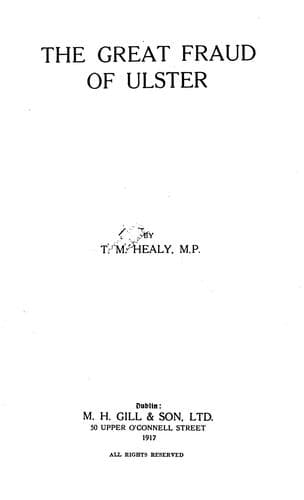
The great fraud of UlsterHealy, T. M. (Timothy Michael)
History
The great fraud of Ulster
Healy, T. M. (Timothy Michael)
Ireland -- History -- 17th century; Ulster (Northern Ireland and Ireland) -- History
The Bill repealed all previous Fishery Acts, and, as introduced
by the Government, contained no recognition of a public right of
fishing, because the English Acts contain none. To this O’Connell’s
Committee demurred, and a clause was unanimously inserted overriding
the English principle and admitting the existence of public right in
Ireland. By decisive words solemnly agreed to, a vital difference
was established in the fishery law of the two countries. Confronted
by this fact, the Lord Chancellor of a Home Rule Ministry in 1908
overcame its force by laying down that “There was a misapprehension
as to the law” in the minds of the law-makers who framed the
enactment. Apparently, therefore, when the Imperial Parliament is
persuaded to legislate for special Irish conditions, and declines to
saddle Ireland with English usages, it “misapprehends the law.”
CHAPTER XXIX.
THE LORDS DIVIDED.
In 1910 the fishermen appealed to the House of Lords. After a week’s
debate that tribunal stood equally divided, and a second hearing
was ordered. The arguments were renewed before seven peers, but the
misdeeds of the Hamiltons, Chichesters, Clotworthys, and Donegalls
were then unknown. Still their Patents so little impressed Lord
Chancellor Loreburn, Lord Shaw, and Lord Robson that they refused to
allow them to prevail against ancient user.
In England and Scotland, neither Thames nor Tweed, Lake Windermere
nor Loch Lomond, is an appanage of royalty. The frontagers who own
the banks enjoy therewith the “bed and soil,” which is nowhere a
“flower of the Crown.” To enforce a contrary rule in Ireland strong
reasons should appear. Nevertheless, the Patents, in the light
presented by the archivist, satisfied Lords Halsbury, Macnaghten, and
Dunedin. They not unnaturally assumed that such grants would not have
been issued without the King’s sanction, nor unless the Crown owned
everything they gave away.
How James I. acquired the fisheries they could not explain, and Lord
Dunedin admitted this frankly:—“It is impossible to point to any
forfeiture which identified the Lough. Yet it was obviously very
probable that it was included in the various territories forfeited to
the Crown in the time of the O’Neills.”
Public-domain text, read in full here on John Shaqi.
Reviews
Reviews
No reviews yet
Be the first to share your thoughts on this work.
Elsewhere in the archive
Join the Discussion
Join the discussion
Sign in to leave a comment or review.
Sign InorCreate an account