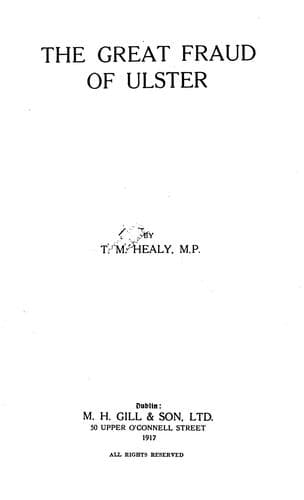
The great fraud of UlsterHealy, T. M. (Timothy Michael)
History
The great fraud of Ulster
Healy, T. M. (Timothy Michael)
Ireland -- History -- 17th century; Ulster (Northern Ireland and Ireland) -- History
This was a hopelessly mistaken deliverance. The Inquisition was an
“Antrim Inquisition,” but the Commission for it extended to Down as
well. It first sat at Ardwhin (recté Ardquin), where no reference to
the fisheries was made. Moreover, the Antrim Inquisition does not
find that “Queen Elizabeth was entitled to one-half of Lough Neagh.”
The translation by the “archivist” was:—
“All that moiety of the pool of Lough Neagh which lies towards the
east parcel of Claneboy aforesaid in the county aforesaid.”
This was merely a finding as to the half of a “pool” lying in the
district to which the jurors were confined, and not one for half
Lough Neagh.
The Record Office translation published years before the litigation,
the work of a brilliant scholar, does not even employ the word
“one-half.” Whatever be the meaning of “medietas,” it is in this
“return” confined to something in Claneboy. Dr. Smith’s Latin
dictionary gives for its equivalent “the mean,” and states it is “a
word doubtfully coined by Cicero from the Greek.”
In enlarging the scope of the Antrim Inquisition beyond Claneboy Lord
Macnaghten displayed much intrepidity. His conjecture that “Probably
there were other inquisitions dealing with the rest of the lough” is
still more rash. No trace of them exists, and none ever existed.
The confiscators took the utmost care to preserve all writings
which could warrant their possession. Chichester ordered the Antrim
inquisition, not to help Hamilton, but to block him. They were then
rivals, if not enemies. When they became allies soon afterwards no
Crown title existed to justify Hamilton’s Patent for Lough Neagh
and the Bann. Every stretch of the river was in legitimate private
ownership under English law, save the monastery reaches. The Lough
lay in no man’s private wallet—as was then notorious.
Never before was “fancy” History invented to decide the fate of real
property in the House of Lords.
Preferable, indeed, is the title invented by the ex-monk, Miler
Magrath, who, when converted into a Protestant Archbishop of Cashel,
was got to visit London in Elizabeth’s reign, and in a “book set
down in writing by her Majesty’s express commandment” declared in
1592:—“It is holden for an opinion in Ireland that her Majesty hath
special right and interest in all principal rivers, loughs, lakes and
great waters, in all islands and commodities contained upon them.”
Miler, however, added a doubt:—“If this opinion be true ... I am not
sure of it.” From that day to the present no one else has been able
to invent a better title for the Crown to grant away Lough Neagh.
Lord Macnaghten was deeply impressed by the litigation in the Irish
House of Lords. He quoted Lord Clare’s account of his going to Armagh
when Attorney-General to dispute Lord Donegall’s title (omitting his
error as to the Act of Settlement) and declared:—
Public-domain text, read in full here on John Shaqi.
Reviews
Reviews
No reviews yet
Be the first to share your thoughts on this work.
Elsewhere in the archive
Join the Discussion
Join the discussion
Sign in to leave a comment or review.
Sign InorCreate an account