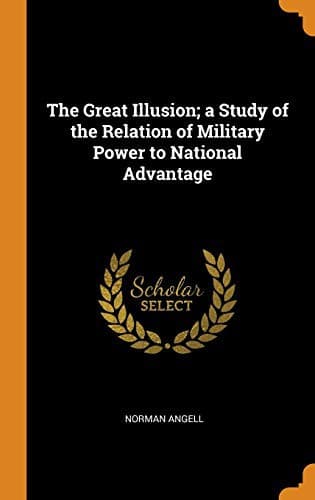
The Great Illusion: A Study of the Relation of Military Power to National AdvantageAngell, Norman
History
The Great Illusion: A Study of the Relation of Military Power to National Advantage
Angell, Norman
Commercial policy; Disarmament; Imperialism; War; War, Cost of
Mr. Lecky, who of all authors has written most suggestively, perhaps, on
the disappearance of religious persecution, has pointed out that the
strife between opposing religious bodies arose out of a religious spirit
which, though often high-minded and disinterested (he protests with
energy against the notion that persecution as a whole was dictated by
interested motives), was unpurified by rationalism; and he adds that the
irrationality which once characterized the religious sentiment has now
been replaced by the irrationality of patriotism. Mr. Lecky says:
If we take a broad view of the course of history, and examine
the relations of great bodies of men, we find that religion
and patriotism are the chief moral influences to which they
have been subjected, and that the separate modifications and
mutual interaction of these two agents may almost be said to
constitute the moral history of mankind.
Is it to be expected that the rationalization and humanization which
have taken place in the more complex domain of religious doctrine and
belief will not also take place in the domain of patriotism? More
especially, as the same author points out, since it was the necessities
of material interest which brought about the reform in the first domain,
and since "not only does interest, as distinct from passion, gain a
greater empire with advancing civilization, but passion itself is mainly
guided by its power."
Have we not abundant evidence, indeed, that the passion of patriotism,
as divorced from material interest, is being modified by the pressure of
material interest? Are not the numberless facts of national
interdependence, which I have indicated here, pushing inevitably to that
result? And are we not justified in concluding that, just as the
progress of rationalism has made it possible for the various religious
groups to live together, to exist side by side without physical
conflict; just as there has been in that domain no necessary choice
between universal domination or unending strife, so in like manner will
the progress of political rationalism mark the evolution of the
relationship of political groups; that the struggle for domination will
cease because it will be realized that physical domination is futile,
and that instead of either universal strife or universal domination
there will come, without formal treaties or Holy Alliances, the general
determination for each to go his way undisturbed in his political
allegiance, as he is now undisturbed in his religious allegiance?
Public-domain text, read in full here on John Shaqi.
Reviews
Reviews
No reviews yet
Be the first to share your thoughts on this work.
Elsewhere in the archive
Join the Discussion
Join the discussion
Sign in to leave a comment or review.
Sign InorCreate an account