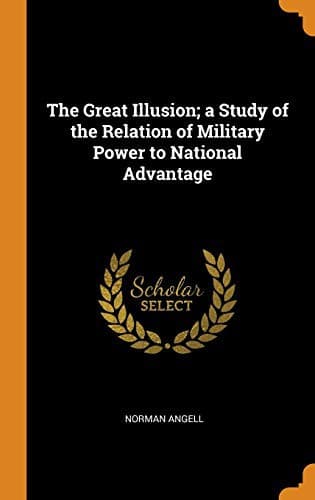
The Great Illusion: A Study of the Relation of Military Power to National AdvantageAngell, Norman
History
The Great Illusion: A Study of the Relation of Military Power to National Advantage
Angell, Norman
Commercial policy; Disarmament; Imperialism; War; War, Cost of
Barrack life is bad. Barrack life will always be bad. It is
never good for a lot of men to live together apart from home
influences and feminine. It is not good for women to live or
work in communities of women. The sexes react upon each other;
each provides for the other a natural restraint, a wholesome
incentive.... The barracks and the garrison town are not good
for young men. The young soldier, fenced and hemmed in by a
discipline unnecessarily severe, and often stupid, has at the
same time an amount of license which is dangerous to all but
those of strong good sense and strong will. I have seen clean,
good, nice boys come into the Army and go to the devil in less
than a year. I am no Puritan. I am a man of the world; but any
sensible and honest man who has been in the Army will know at
once that what I am saying is entirely true, and is the truth
expressed with much restraint and moderation. A few hours in a
barrack-room would teach a civilian more than all the soldier
stories ever written. When I joined the Army I was unusually
unsophisticated for a boy of twenty. I had been brought up by a
mother. I had attended Sunday-school and chapel. I had lived a
quiet, sheltered life, and I had an astonishing amount to
learn. The language of the barrack-room shocked me, appalled
me. I could not understand half I heard; I could not credit
much that I saw. When I began to realize the truth, I took my
courage in both hands and went about the world I had come into
with open eyes. So I learnt the facts, but I must not tell
them.[86]
CHAPTER V
THE DIMINISHING FACTOR OF PHYSICAL FORCE: PSYCHOLOGICAL RESULTS
Diminishing factor of physical force--Though diminishing, physical
force has always had an important rôle in human affairs--What is
underlying principle, determining advantageous and disadvantageous
use of physical force?--Force that aids co-operation in accord
with law of man's advance: force that is exercised for
parasitism in conflict with such law and disadvantageous for
both parties--Historical process of the abandonment of physical
force--The Khan and the London tradesman--Ancient Rome and modern
Britain--The sentimental defence of war as the purifier of human
life--The facts--The redirection of human pugnacity.
Despite the general tendency indicated by the facts dealt with in the
preceding chapter, it will be urged (with perfect justice) that, though
the methods of Anglo-Saxondom as compared with those of the Spanish,
Portuguese, and French Empires, may have been mainly commercial and
industrial rather than military, war was a necessary part of expansion;
that but for some fighting the Anglo-Saxons would have been ousted from
North America or Asia, or would never have gained a footing there.
Public-domain text, read in full here on John Shaqi.
Reviews
Reviews
No reviews yet
Be the first to share your thoughts on this work.
Elsewhere in the archive
Join the Discussion
Join the discussion
Sign in to leave a comment or review.
Sign InorCreate an account