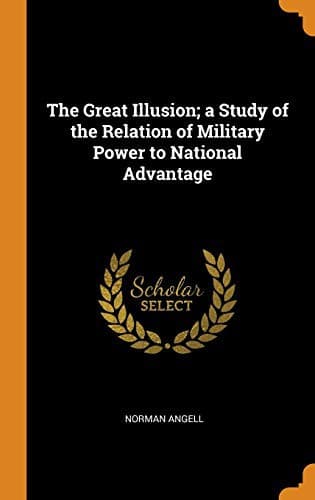
The Great Illusion: A Study of the Relation of Military Power to National AdvantageAngell, Norman
History
The Great Illusion: A Study of the Relation of Military Power to National Advantage
Angell, Norman
Commercial policy; Disarmament; Imperialism; War; War, Cost of
which at the other end of the scale a London tradesman will spend on a
restaurant dinner for the purpose of sitting at table with a duke--or
the thousandth part of the sum which the same tradesman will spend in
philanthropy or otherwise, for the sake of acquiring an empty title from
a monarch who has lost all power of exercising any physical force
whatsoever.
Which process, judged by all things that men desire, gives the better
result, the physical force of blood and iron which we see, or the
intellectual or psychic force which we cannot see? The principle which
operates in the limited fashion which I have indicated, operates with no
less force in the larger domain of modern international politics. The
wealth of the world is not represented by a fixed amount of gold or
money now in the possession of one Power, and now in the possession of
another, but depends on all the unchecked multiple activities of a
community for the time being. Check that activity, whether by imposing
tribute, or disadvantageous commercial conditions, or an unwelcome
administration which sets up sterile political agitation, and you get
less wealth--less wealth for the conqueror, as well as less for the
conquered. The broadest statement of the case is that all
experience--especially the experience indicated in the last
chapter--shows that in trade by free consent, carrying mutual benefit,
we get larger results for effort expended than in the exercise of
physical force, which attempts to exact advantage for one party at the
expense of the other. I am not arguing over again the thesis of the
first part of this book; but, as we shall see presently, the general
principle of the diminishing factor of physical force in the affairs of
the world carries with it a psychological change in human nature which
modifies radically our impulses to sheer physical conflict. What it is
important just now to keep in mind, is the incalculable intensification
of this diminution of physical force by our mechanical development. The
principle was obviously less true for Rome than it is for Great Britain
or America: Rome, however imperfectly, lived largely by tribute. The
sheer mechanical development of the modern world has rendered tribute in
the Roman sense impossible. Rome did not have to create markets and find
a field for the employment of her capital. We do. What result does this
carry? Rome could afford to be relatively indifferent to the prosperity
of her subject territory. We cannot. If the territory is not prosperous
we have no market, and we have no field for our investments, and that is
why we are checked at every point from doing what Rome was able to do.
You can to some extent exact tribute by force; you cannot compel a man
to buy your goods by force if he does not want them, and has not got the
money to pay for them. Now, the difference which we see here has been
brought about by the interaction of a whole series of mechanical
Public-domain text, read in full here on John Shaqi.
Reviews
Reviews
No reviews yet
Be the first to share your thoughts on this work.
Elsewhere in the archive
Join the Discussion
Join the discussion
Sign in to leave a comment or review.
Sign InorCreate an account