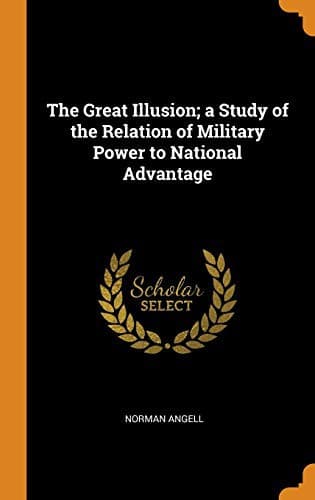
The Great Illusion: A Study of the Relation of Military Power to National AdvantageAngell, Norman
History
The Great Illusion: A Study of the Relation of Military Power to National Advantage
Angell, Norman
Commercial policy; Disarmament; Imperialism; War; War, Cost of
Is it not somewhat childish and elementary to conceive of force only as
the firing off of guns and the launching of _Dreadnoughts_, of struggle
as the physical struggle between men, instead of the application of
man's energies to his contest with the planet? Is not the time coming
when the real struggle will inspire us with the same respect and even
the same thrill as that now inspired by a charge in battle; especially
as the charges in battle are getting very out of date, and are shortly
to disappear from our warfare? The mind which can only conceive of
struggle as bombardment and charges is, of course, the Dervish mind. Not
that Fuzzy-Wuzzy is not a fine fellow. He is manly, sturdy, hardy, with
a courage, and warlike qualities generally, which no European can equal.
But the frail and spectacled English official is his master, and a few
score of such will make themselves the masters of teeming thousands of
Sudanese; the relatively unwarlike Englishman is doing the same thing
all over Asia, and he is doing it simply by virtue of superior brain
and character, more thought, more rationalism, more steady and
controlled hard work. The American is doing the same in the Philippines.
It may be said that it is superior armament which does it. But what is
the superior armament but the result of superior thought and work? And
even without the superior armament the larger intelligence would still
do it; for what the Englishman and American do, the Roman did of old,
with the same arms as the inhabitants of his vassal worlds. Force is
indeed the master, but it is the force of intelligence, character, and
rationalism.
I can imagine the contempt with which the man of physical force greets
the foregoing. To fight with words, to fight with talk! No, not words,
but ideas. And something more than ideas. Their translation into
practical effort, into organization, into the direction and
administration of organization, into the strategy and tactics of human
life.
Public-domain text, read in full here on John Shaqi.
Reviews
Reviews
No reviews yet
Be the first to share your thoughts on this work.
Elsewhere in the archive
Join the Discussion
Join the discussion
Sign in to leave a comment or review.
Sign InorCreate an account