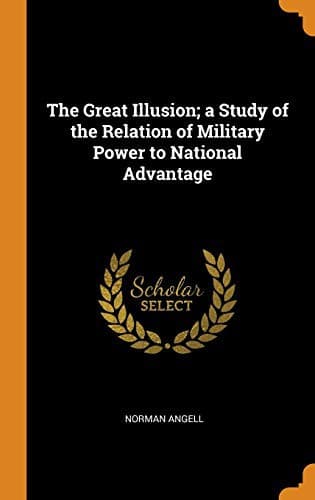
The Great Illusion: A Study of the Relation of Military Power to National AdvantageAngell, Norman
History
The Great Illusion: A Study of the Relation of Military Power to National Advantage
Angell, Norman
Commercial policy; Disarmament; Imperialism; War; War, Cost of
Despite the common idea to the contrary, we dearly love an
abstraction--especially, apparently, an abstraction which is based on
half the facts. Whatever the foregoing chapters may have proved, they
have at least proved this: that the character of the modern State, by
virtue of a multitude of new factors which are special to our age, is
essentially and fundamentally different from that of the ancient. Yet
even those who have great and justified authority in this matter will
still appeal to Aristotle's conception of the State as final, with the
implication that everything which has happened since Aristotle's time
should be calmly disregarded.
What some of those things are, the preceding chapters have indicated:
First, there is the fact of the change in human nature itself, bound up
with the general drift away from the use of physical force--a drift
explained by the unromantic fact that physical force does not give so
much response to expended effort as do other forms of energy. There is
an interconnection of psychological and purely mechanical development in
all this which it is not necessary to disentangle here. The results are
evident enough. Very rarely, and to an infinitesimal extent, do we now
employ force for the achievement of our ends. There is still a factor,
however, which remains to be considered, and which has perhaps a more
direct bearing on the question of continued conflict between nations
than any of the other factors.
Conflicts between nations and international pugnacity generally imply a
conception of a State as a homogeneous whole, having the same sort of
responsibility that we attach to a person who, hitting us, provokes us
to hit back. Now only to a very small and rapidly diminishing extent can
a State be regarded as such a person. There may have been a
time--Aristotle's time--when this was possible; but it is now
impossible. Yet the fine-spun theories on which are based the necessity
for the use of force, as between nations, and the proposition that the
relationship of nations can only be determined by force, and that
international pugnacity will always be expressed by a physical struggle
between nations, all arise from this fatal analogy, which in truth
corresponds to very few of the facts.
Thus Professor Spenser Wilkinson, whose contributions to this subject
have such deserved weight, implies that what will permanently render
the abandonment of force between nations impossible is the principle
that "the employment of force for the maintenance of right is the
foundation of all civilized human life, for it is the fundamental
function of the State, and apart from the State there is no
civilization, no life worth living.... The mark of the State is
sovereignty, or the identification of force and right, and the measure
of the perfection of the State is furnished by the completeness of this
identification."
Public-domain text, read in full here on John Shaqi.
Reviews
Reviews
No reviews yet
Be the first to share your thoughts on this work.
Elsewhere in the archive
Join the Discussion
Join the discussion
Sign in to leave a comment or review.
Sign InorCreate an account