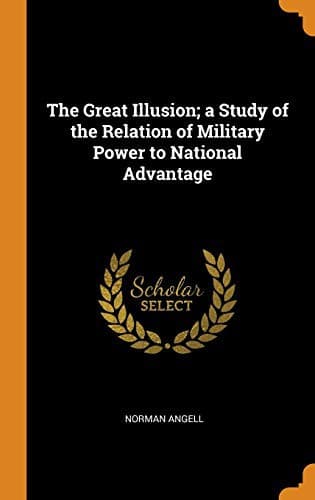
The Great Illusion: A Study of the Relation of Military Power to National AdvantageAngell, Norman
History
The Great Illusion: A Study of the Relation of Military Power to National Advantage
Angell, Norman
Commercial policy; Disarmament; Imperialism; War; War, Cost of
How do we know that these difficulties are doctrinaire ones? It is the
British Empire which supplies the answer. The British Empire is made up
in large part of practically independent States, and Great Britain not
only exercises no control over their acts, but has surrendered in
advance any intention of employing force concerning them.[103] The
British States have disagreements among themselves. They may or may not
refer their differences to the British Government, but if they do, is
Great Britain going to send an army to Canada, say, to enforce her
judgment? Everyone knows that that is impossible. Even when one State
commits what is in reality a serious breach of international comity on
another, not only does Great Britain refrain from using force herself,
but so far as she interferes at all, it is to prevent the employment of
physical force. For years now British Indians have been subjected to
most cruel and unjust treatment in the State of Natal.[104] The British
Government makes no secret of the fact that she regards this treatment
as unjust and cruel; were Natal a foreign State, it is conceivable that
she would employ force, but, following the principle laid down by Sir
C.P. Lucas, "whether they are right or whether they are wrong, more
perhaps when they are wrong than when they are right, they cannot be
made amenable by force," the two States are left to adjust the
difficulty as best they may, without resort to force. In the last resort
the British Empire reposes upon the expectation that its Colonies will
behave as civilized communities, and in the long run the expectation is,
of course, a well-founded one, because, if they do not so behave,
retribution will come more surely by the ordinary operation of social
and economic forces than it could come by any force of arms.
The case of the British Empire is not an isolated one. The fact is that
most of the States of the world maintain their relations one with
another without any possibility of a resort to force; half the States of
the world have no means of enforcing by arms such wrongs as they may
suffer at the hands of other States. Thousands of Englishmen, for
instance, make their homes in Switzerland, and it has happened that
wrongs have been suffered by Englishmen at the hands of the Swiss
Government. Would, however, the relations between the two States, or the
practical standard of protection of British subjects in Switzerland, be
any the better were Switzerland the whole time threatened by the might
of Great Britain? Switzerland knows that she is practically free from
the possibility of the exercise of that force, but this has not
prevented her from behaving as a civilized community towards British
subjects.
Public-domain text, read in full here on John Shaqi.
Reviews
Reviews
No reviews yet
Be the first to share your thoughts on this work.
Elsewhere in the archive
Join the Discussion
Join the discussion
Sign in to leave a comment or review.
Sign InorCreate an account