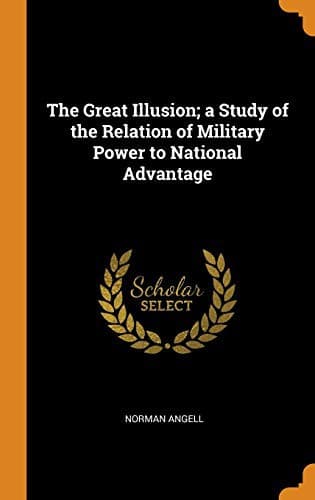
The Great Illusion: A Study of the Relation of Military Power to National AdvantageAngell, Norman
History
The Great Illusion: A Study of the Relation of Military Power to National Advantage
Angell, Norman
Commercial policy; Disarmament; Imperialism; War; War, Cost of
Some years ago the bank in a Western mining town was frequently
subjected to "hold-ups," because it was known that the great mining
company owning the town kept large quantities of gold there for the
payment of its workmen. The company, therefore, took to paying its
wages mainly by check on a San Francisco bank, and by a simple system of
clearances practically abolished the use of gold in considerable
quantities in the mining town in question. The bank was never attacked
again.
Now, the demonstration that gold had been replaced by books in that bank
was as much a work of defence as though the bank had spent tens of
thousands of dollars in constructing forts and earthworks, and mounting
Gatling guns around the town. Of the two methods of defence, that of
substituting checks for gold was infinitely cheaper, and more effective.
Even if the inferences which the _Spectator_ reviewer draws were true
ones, which for the most part they are not, he still overlooks one
important element. If it were true that the book involves the "folly of
patriotism," how is that in any way relevant to the discussion, since I
also urge that nations are justified in protecting even their follies
against the attack of other nations? I may regard the Christian
Scientists, or the Seventh Day Adventists, or the Spiritualists, as very
foolish people, and to some extent mischievous people; but were an Act
of Parliament introduced for their suppression by physical force, I
should resist such an act with all the energy of which I was capable. In
what way are the two attitudes contradictory? They are the attitudes, I
take it, of educated men the world over. The fact has no importance, and
it hardly bears on this subject, but I regard certain English
conceptions of life bearing on matters of law, and social habit, and
political philosophy, as infinitely preferable to the German, and if I
thought that such conceptions demanded defence indefinitely by great
armaments this book would never have been written. But I take the view
that the idea of such necessity is based on a complete illusion, not
only because as a matter of present-day fact, and even in the present
state of political philosophy, Germany has not the least intention of
going to war with us to change our notions in law or literature, art or
social organization, but also because if she had any such notion it
would be founded upon illusions which she would be bound sooner or later
to shed, because German policy could not indefinitely resist the
influence of a general European attitude on such matters any more than
it has been possible for any great and active European State to stand
outside the European movement which has condemned the policy of
attempting to impose religious belief by the physical force of the
State. And I should regard it as an essential part of the work of
defence to aid in the firm establishment of such a European doctrine, as
much a part of the work of defence as it would be to go on building
Public-domain text, read in full here on John Shaqi.
Reviews
Reviews
No reviews yet
Be the first to share your thoughts on this work.
Elsewhere in the archive
Join the Discussion
Join the discussion
Sign in to leave a comment or review.
Sign InorCreate an account