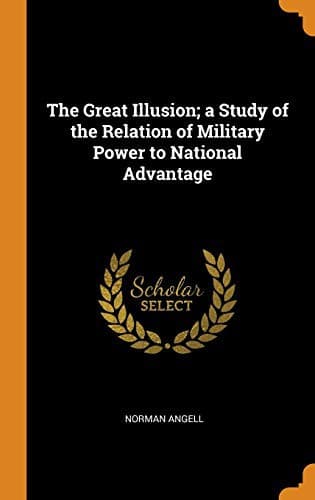
The Great Illusion: A Study of the Relation of Military Power to National AdvantageAngell, Norman
History
The Great Illusion: A Study of the Relation of Military Power to National Advantage
Angell, Norman
Commercial policy; Disarmament; Imperialism; War; War, Cost of
When things moved so slowly, a generation or two sufficed to transform
the mind of Europe on the religious side. Why should it be impossible to
change that mind on the political side in a generation, or half a
generation, when things move so much more quickly? Are men less disposed
to change their political than their religious opinions? We all know
that _not_ to be the case. In every country in Europe we find political
parties advocating, or at least acquiescing in, policies which they
strenuously opposed ten years ago. Does the evidence available go to
show that the particular side of politics with which we are dealing is
notably more impervious to change and development than the rest--less
within the reach and influence of new ideas?
I must risk here the reproach of egotism and bad taste to call attention
to a fact which bears more directly on that point, perhaps, than any
other that could be cited.
It is some fifteen years since it first struck me that certain economic
facts of our civilization--facts of such visible and mechanical nature
as reacting bourses and bank rate-movements, in all the economic
capitals of the world, and so on--would soon force upon the attention of
men a principle which, though existing for long past in some degree in
human affairs, had not become operative to any extent. Was there any
doubt as to the reality of the material facts involved? Circumstances of
my occupation happily furnished opportunities of discussing the matter
thoroughly with bankers and statesmen of world-wide authority. There was
no doubt on that score. Had we yet arrived at the point at which it was
possible to make the matter plain to general opinion? Were politicians
too ill-educated on the real facts of the world, too much absorbed in
the rough-and-tumble of workaday politics to change old ideas? Were
they, and the rank and file, still too enslaved by the hypnotism of an
obsolete terminology to accept a new view? One could only put it to a
practical test. A brief exposition of the cardinal principles was
embodied in a brief pamphlet and published obscurely without
advertisement, and bearing, necessarily, an unknown name. The result
was, under the circumstances, startling, and certainly did not justify
in the least the plea that there exists universal hostility to the
advance of political rationalism. Encouragement came from most
unlooked-for quarters: public men whose interests have been mainly
military, alleged Jingoes, and even from soldiers. The more considerable
edition has appeared in English, German, French, Dutch, Danish, Swedish,
Spanish, Italian, Russian, Japanese, Erdu, Persian, and Hindustani, and
nowhere has the Press completely ignored the book. Papers of Liberal
tendencies have welcomed it everywhere. Those of more reactionary
tendencies have been much less hostile than one could have
expected.[121]
Public-domain text, read in full here on John Shaqi.
Reviews
Reviews
No reviews yet
Be the first to share your thoughts on this work.
Elsewhere in the archive
Join the Discussion
Join the discussion
Sign in to leave a comment or review.
Sign InorCreate an account