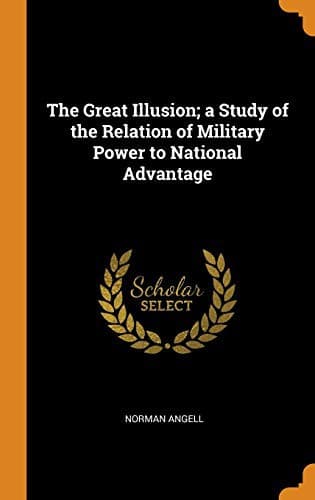
The Great Illusion: A Study of the Relation of Military Power to National AdvantageAngell, Norman
History
The Great Illusion: A Study of the Relation of Military Power to National Advantage
Angell, Norman
Commercial policy; Disarmament; Imperialism; War; War, Cost of
Of course, it is true that many of the factors bearing on this
improvement will be indirect. As our education becomes more rational in
other fields, it will make for understanding in this; as the visible
factors of our civilization make plain--as they are making plainer every
day--the unity and interdependence of the modern world, the attempt to
separate those interdependent activities by irrelevant divisions must
more and more break down. All improvement in human co-operation--and
human co-operation is a synonym for civilization--must help the work of
those laboring in the field of international relationship. But again I
would reiterate that the work of the world does not get itself done. It
is done by men; ideas do not improve themselves, they are improved by
the thought of men; and it is the efficiency of the conscious effort
which will mainly determine progress.
When all nations realize that if England can no longer exert force
towards her Colonies, others certainly could not; that if a great modern
Empire cannot usefully employ force as against communities that it
"owns," still less can we employ it usefully against communities that
we do not "own"; when the world as a whole has learned the real lesson
of British Imperial development, not only will that Empire have achieved
greater security than it can achieve by battleships, but it will have
played a part in human affairs incomparably greater and more useful than
could be played by any military "leadership of the human race," that
futile duplication of the Napoleonic rôle, which Imperialists of a
certain school seem to dream for us.
It is to Anglo-Saxon practice, and to Anglo-Saxon experience, that the
world will look as a guide in this matter. The extension of the
dominating principle of the British Empire to European society as a
whole is the solution of the international problem which this book
urges. That extension cannot be made by military means. The English
conquest of great military nations is a physical impossibility, and it
would involve the collapse of the principle upon which the Empire is
based if it were. The day for progress by force has passed; it will be
progress by ideas or not at all.
Because these principles of free human co-operation between communities
are, in a special sense, an Anglo-Saxon development, it is upon us that
there falls the responsibility of giving a lead. If it does not come
from us, who have developed these principles as between all the
communities which have sprung from the Anglo-Saxon race, can we ask to
have it given elsewhere? If we have not faith in our own principles, to
whom shall we look?
English thought gave us the science of political economy; Anglo-Saxon
thought and practice must give us another science, that of International
Polity--the science of the political relationship of human groups. We
have the beginnings of it, but it sadly needs systemization--recognition
by those intellectually equipped to develop it and enlarge it.
Public-domain text, read in full here on John Shaqi.
Reviews
Reviews
No reviews yet
Be the first to share your thoughts on this work.
Elsewhere in the archive
Join the Discussion
Join the discussion
Sign in to leave a comment or review.
Sign InorCreate an account