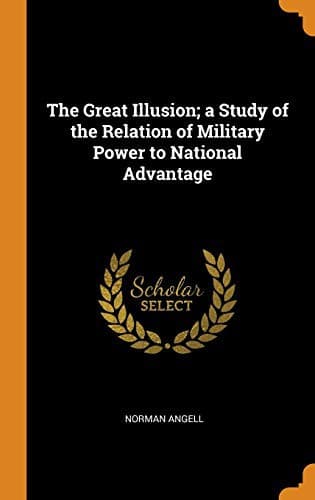
The Great Illusion: A Study of the Relation of Military Power to National AdvantageAngell, Norman
History
The Great Illusion: A Study of the Relation of Military Power to National Advantage
Angell, Norman
Commercial policy; Disarmament; Imperialism; War; War, Cost of
"While the Christian does not believe in robbery inside the
frontier, he does without; while within the State he realizes
that it is better for each to observe the general code, so that
civilized society can exist, than for each to disregard it, so
that society goes to pieces; while within the State he realizes
that government is a matter of administration, not the seizure
of property; that one town does not add to its wealth by
'capturing' another, that indeed one community cannot 'own'
another--while, I say, he believes all these things in his
daily life at home, he disregards them all when he comes to the
field of international relationship, _la haute politique_. To
annex some province by a cynical breach of treaty obligation
(Austria in Bosnia, Italy in Tripoli) is regarded as better
politics than to act loyally with the community of nations to
enforce their common interest in order and good government. In
fact, we do not believe that there can be a community of
nations, because, in fact, we do not believe that their
interests are common, but rival; like the Turk, we believe that
if you do not exercise force upon your 'rival' he will exercise
it upon you; that nations live upon one another, not by
co-operation with one another--and it is for this reason
presumably that you must 'own' as much of your neighbors as
possible. It is the Turkish conception from beginning to end.
"It is because these false beliefs prevent the nations of
Christendom acting loyally the one to the other, because each
is playing for its own hand, that the Turk, with hint of some
sordid bribe, has been able to play off each against the other.
"This is the crux of the matter. When Europe can honestly act
in common on behalf of common interests some solution can be
found. And the capacity of Europe to act in harmony will not be
found as long as the accepted doctrines of European statecraft
remain unchanged, as long as they are dominated by existing
illusions."
FOOTNOTES:
[1] "The True Way of Life" (Headley Brothers, London), p. 29. I am aware
that many modern pacifists, even of the English school, to which these
remarks mainly apply, are more objective in their advocacy than Mr.
Grubb, but in the eyes of the "average sensual man" pacificism is still
deeply tainted with this self-sacrificing altruism (see Chapter III.,
Part III.), notwithstanding the admirable work of the French pacifist
school.
Public-domain text, read in full here on John Shaqi.
Reviews
Reviews
No reviews yet
Be the first to share your thoughts on this work.
Elsewhere in the archive
Join the Discussion
Join the discussion
Sign in to leave a comment or review.
Sign InorCreate an account