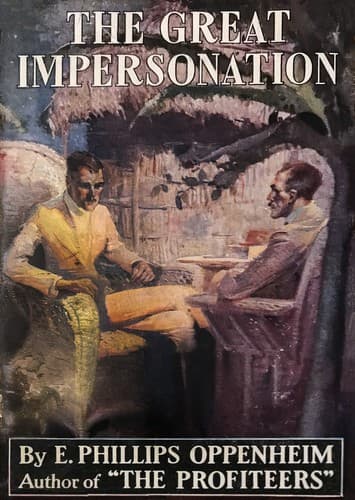
The Great ImpersonationOppenheim, E. Phillips (Edward Phillips)
General
The Great Impersonation
Oppenheim, E. Phillips (Edward Phillips)
Spy stories
These were days, to all dwellers in London, of vivid impressions, of
poignant memories, reasserting themselves afterwards with a curious
sense of unreality, as though belonging to another set of days and
another world. Dominey long remembered his dinner that evening in the
sombre, handsomely furnished dining-room of his town house in Berkeley
Square. Although it lacked the splendid proportions of the banqueting
hall at Dominey, it was still a fine apartment, furnished in the
Georgian period, with some notable pictures upon the walls, and with a
wonderful ceiling and fireplace. Dominey and Rosamund dined alone, and
though the table had been reduced to its smallest proportions, the space
between them was yet considerable. As soon as Parkins had gravely put
the port upon the table, Rosamund rose to her feet and, instead of
leaving the room, pointed for the servant to place a chair for her by
Dominey's side.
“I shall be like your men friends, Everard,” she declared, “when the
ladies have left, and draw up to your side. Now what do we do? Tell
stories? I promise you that I will be a wonderful listener.”
“First of all you drink half a glass of this port,” he declared, filling
her glass, “then you peel me one of those peaches, and we divide it.
After which we listen for a ring at the bell. To-night I expect a
visitor.”
“A visitor?”
“Not a social one,” he assured her. “A matter of business which I fear
will take me from you for the rest of the evening. So let us make the
most of the time until he comes.”
She commenced her task with the peach, talking to him all the time a
little gravely, a sweet and picturesque picture of a graceful and very
desirable woman, her delicate shape and artistic fragility more than
ever accentuated by the sombreness of the background.
“Do you know, Everard,” she said, “I am so happy in London here
with you, and I feel all the time so strong and well. I can read and
understand the books which were a maze of print to me before. I can
see the things in the pictures, and feel the thrill of the music, which
seemed to come to me, somehow, before, all dislocated and discordant.
You understand, dear?”
“Of course,” he answered gravely.
“I do not wonder,” she went on, “that Doctor Harrison is proud of me for
a patient, but there are many times when I feel a dull pain in my heart,
because I know that, whatever he or anybody else might say, I am not
quite cured.”
“Rosamund dear,” he protested.
“Ah, but don't interrupt,” she insisted, depositing his share of the
peach upon his plate. “How can I be cured when all the time there is the
problem of you, the problem which I am just as far off solving as ever I
was? Often I find myself comparing you with the Everard whom I married.”
“Do I fail so often to come up to his standard?” he asked.
Public-domain text, read in full here on John Shaqi.
Reviews
Reviews
No reviews yet
Be the first to share your thoughts on this work.
Elsewhere in the archive
Join the Discussion
Join the discussion
Sign in to leave a comment or review.
Sign InorCreate an account