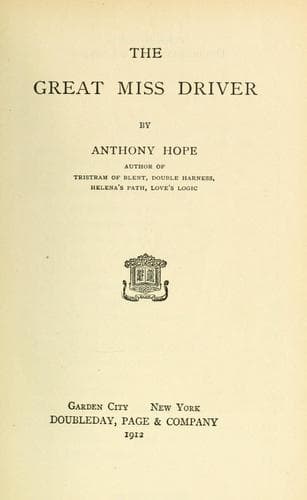
Elopement -- Fiction; Inheritance and succession -- Fiction; Private secretaries -- Fiction; Young women -- Fiction
Her private relations, though by no means free from difficulty, were at
the moment hardly less flattering to her sense of self-importance,
hardly less eloquent of her power. Fillingford was ready to offer her
all he had--his name, his rank, his stately Manor; Octon lingered at
Hatcham Ford, hoping against hope for her, unable to go because it was
her will that he should stay: at her bidding young Lacey was
transforming himself from a gay aspirant to her favor into the
submissive servant of her wishes, her warm and obedient friend. To
consider mere satellites like Cartmell and myself would be an
anti-climax; yet to us, too, crumbs of kindness fell from the rich man's
table and did their work of binding us closer to Jenny.
If she stayed as she was--the powerful, important Miss Driver--she was
very well. If she married Fillingford, she hardly strengthened her
position, but she decorated it highly, and widened the sphere of her
influence. If she chose to take the risks and openly accepted Octon, she
would indeed strain and impair the fabric she had built, but she could
hardly so injure it that time and skill would not build it again as good
as new. But she would make up her mind to none of the three. She liked
independence and feared its loss by marriage. She liked splendor and
rank, and therefore kept her hold on Fillingford's offer. Finally, she
must like Octon himself, must probably in her heart cling more to him
than she had admitted even to herself; there was no other reason for
dallying with that decision. Across the play of her politics ran this
strong, this curious, personal attraction; she could not let him go. For
the moment she tried for all these things--the independence, the
prestige of prospective splendor and rank, and--well, whatever she was
getting out of the presence of Octon at Hatcham Ford, across the road
from her offices at Ivydene.
It was a delicate equipoise--the least thing might upset it, and in its
fall it might involve much that was of value to Jenny. There was at
least one person who was not averse from anything which would set a
check to Jenny's plans and shake her power.
Jenny and I had been to Fillingford Manor--where, by the way, I took the
opportunity of inspecting Mistress Eleanor Lacey's picture, Fillingford
acting as my guide and himself examining it with much apparent
interest--and, as we drove home, she said to me suddenly:
"Why does Lady Sarah dislike me so much?"
"She has three excellent reasons. You eclipse her, you threaten her, and
you dislike her."
"How does she know I dislike her?"
"How do you know she dislikes you, if you come to that? You women always
seem to me to have special antennae for finding out dislikes. I don't
mean to say they're infallible."
"At any rate Lady Sarah and I seem to agree in this case," laughed
Jenny. "She's right if she thinks I dislike her, and I'm certainly right
in thinking she dislikes me. But how do I threaten her?"
Public-domain text, read in full here on John Shaqi.
Reviews
Reviews
No reviews yet
Be the first to share your thoughts on this work.
Elsewhere in the archive
Join the Discussion
Join the discussion
Sign in to leave a comment or review.
Sign InorCreate an account