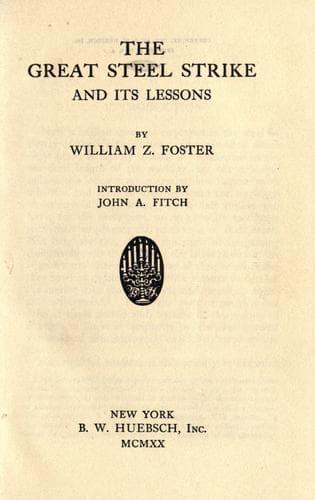
The Great Steel Strike and its LessonsFoster, William Z.
History
The Great Steel Strike and its Lessons
Foster, William Z.
Steel Strike, U.S., 1919-1920; United States Steel Corporation
Cleveland from the first to the last was one of the strong points in
the battle line. On September 22 the men struck almost 100 per cent. in
all the big plants, and until the very end preserved a wonderful
solidarity. Under the excellent control of the organizers working with
Secretary Raisse there was at no time a serious break in the ranks, and
when the strike was called off on January 8, at least 50 per cent. of
the men were still out, with production not over 30 per cent. of normal.
Thousands of the men refused to go back to the mills at all, leaving
them badly crippled.
The backbone of the Cleveland strike was the enormous mills of the
American Steel and Wire Co. This calls attention to the fact that, as a
whole, the employees of this subsidiary of the U. S. Steel Corporation
made incomparably a better fight than did the workers in any other
considerable branch of the steel industry. Long after the strike had
been cracked in all other sections of the industry, the rod and wire
mill men of Cleveland, Donora, Braddock, Rankin, Joliet and Waukegan
stood practically solid. Even as late as December 27, only twelve days
before the end, the companies were forced to the expedient of assembling
a rump meeting in Cleveland of delegates from many centres, for the
purpose of calling off the strike. But the men voted unanimously for
continuation under the leadership of the National Committee. When the
strike was finally ended, however, they accepted the decision with good
grace, because they were penetrated with the general strike idea and
realized the folly of trying alone to whip the united steel companies.
The remarkable fight of the rod and wire mill men was due in large
measure to the peculiar circumstances surrounding their organization.
These are highly important and require explanation: The regular system
used by the National Committee resulted usually in organization from the
bottom upward; that is, in response to the general appeals made to the
men in the great mass meetings, ordinarily the first to join the unions
were the unskilled, who are the workers with the least to lose, the most
to gain, and consequently those most likely to take a chance. Gradually,
as the confidence of the men developed, the movement would extend on up
through the plants until it included the highest skilled men. Given time
and a reasonable opportunity, it was an infallible system. It was far
superior to the old trade-union plan of working solely from the top
down, because the latter always stopped before it got to the main body
of the men, the unskilled workers.
Public-domain text, read in full here on John Shaqi.
Reviews
Reviews
No reviews yet
Be the first to share your thoughts on this work.
Elsewhere in the archive
Join the Discussion
Join the discussion
Sign in to leave a comment or review.
Sign InorCreate an account