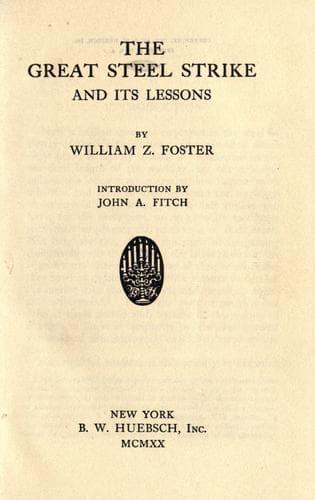
The Great Steel Strike and its LessonsFoster, William Z.
History
The Great Steel Strike and its Lessons
Foster, William Z.
Steel Strike, U.S., 1919-1920; United States Steel Corporation
In order to cover up their own inveterate opposition to Organized Labor
in all its forms and activities, and to blind the workers to the real
cause of the defeat, namely lack of sufficient power on the employees'
side, great employing interests caused to be spread over the whole
country the statement that the steel strike failed because of radical
leadership, and that if such "dangerous" men as John Fitzpatrick and
myself had not been connected with it everything would have been lovely.
They were especially severe against me for my "evil" influence on the
strike. But somehow their propaganda did not seem to strike root among
labor men, especially those who were backing the steel campaign. The
workers are getting too keen these days to let the enemy tell them who
shall or shall not be their officials; and when they see one of these
officials made the target of bitter attack from such notorious interests
as the Steel Trust they are much inclined to feel that he is probably
giving them a square deal.
As for myself, and I know John Fitzpatrick took the same position
regarding himself, I was willing to resign my position on the National
Committee the very instant it was indicated by those associated with me
that my presence was injuring the movement. I felt that to be my duty.
But to the last, that indication never came. When I finally resigned as
Secretary-Treasurer on January 31, it was entirely of my own volition.
The avalanche of vituperation and personal abuse was started several
months before the strike, when a traitor labor paper in Pittsburgh (one
of the stripe which lives by knifing strikes and active unionists for
the employers) published articles containing quotations from the "red
book," and the other stuff later bruited about in the daily press. To
hear this sheet tell it, the revolution was at hand. Immediately after
the articles appeared I sent copies to the presidents of all the
twenty-four co-operating unions, with the result that almost all of
these officials wrote me, advising that I pay no attention to these
attacks, but continue with my work. They seemed to consider it something
of a compliment to be so bitterly assailed from such a quarter. Again,
at the very moment when President Gompers was dictating his letter to
Judge Gary asking for a conference (long after the above-mentioned
attacks) I stated that possibly too much prominence for me in the
movement might attract needless opposition to it and I offered to resign
from the conference committee which handled all negotiations concerning
the steel strike. But my objections were over-ruled and I was continued
on the committee. Moreover, at any time in the campaign a word from the
executive officers of the A. F. of L. would have brought about my
resignation. This they were aware of for months before the strike. All
of which indicates that the men responsible for the organizations in the
movement were satisfied that it was being carried on according to
Public-domain text, read in full here on John Shaqi.
Reviews
Reviews
No reviews yet
Be the first to share your thoughts on this work.
Elsewhere in the archive
Join the Discussion
Join the discussion
Sign in to leave a comment or review.
Sign InorCreate an account