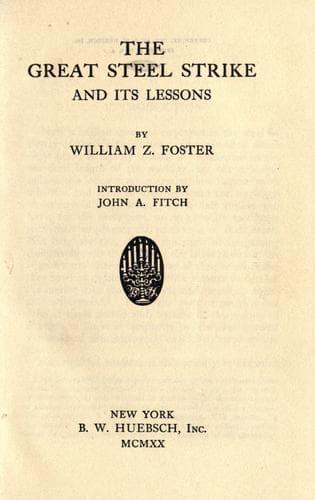
The Great Steel Strike and its LessonsFoster, William Z.
History
The Great Steel Strike and its Lessons
Foster, William Z.
Steel Strike, U.S., 1919-1920; United States Steel Corporation
The question may be pertinently asked, why, if camouflage is such a
potent weapon in social as well as military warfare, should the true
nature and tendency of the trade unions be pointed out, thus stripping
the movement of its philosophic protection and leaving it bare before
its enemies? The answer is that the camouflage works both ways; it
deceives friends as well as enemies. It has thus to a great extent cost
the unions the support of the whole left wing of the labor movement. Its
advantages are outweighed by its disadvantages.
In what I have called the left wing of the movement there are large and
ever-increasing numbers of workers and sympathizers who refuse to face
the prospect of a society forever based upon the wage system. They
demand an organization that is making for its abolition and the
substitution therefor of a system of industrial justice. If they were to
look sharply, they would see that the trade-union movement is traveling
faster than any other body toward the end they wish to reach. But
unfortunately, looking sharply is not their method. They habitually
attach too much importance to surface indications and not enough to real
results. They go almost entirely by preambles and manifestoes.
Consequently, taking the trade-union slogans at their face value and
finding them altogether unsatisfactory, they turn their backs upon the
trade-union movement and give support to the organizations which have
the sort they want, the I. W. W., the W. I. I. U., etc.
This belief, that the trade unions are inherently conservative bodies,
is the basis of the strong conviction that they are hopeless and that
they must be supplanted by a new organization, aiming to abolish the
wage system. The conception is found in some degree or other among
virtually all radicals. And it has done incalculable harm to the unions.
It has cost them the support of thousands of militants, of the best and
most intelligent that the working class produces. These might have done
a wonderful work; but their time and energies have been worse than
wasted in trying to build up organizations such as the I. W. W. When one
considers that the life of nearly every labor union depends upon the
activities of a very small fraction of its membership, it is clear that
this constant drain upon its best blood must have seriously hindered the
advance of the trade-union movement. Many have complained at the slow
progress it has made; but the marvel is rather that it has been able to
progress at all.
Public-domain text, read in full here on John Shaqi.
Reviews
Reviews
No reviews yet
Be the first to share your thoughts on this work.
Elsewhere in the archive
Join the Discussion
Join the discussion
Sign in to leave a comment or review.
Sign InorCreate an account