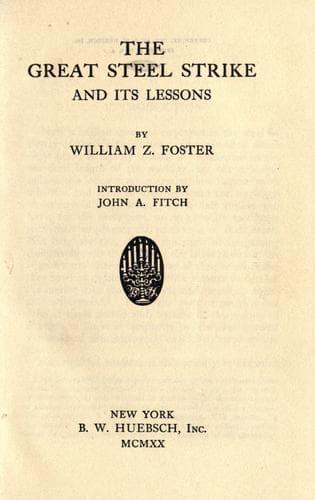
The Great Steel Strike and its LessonsFoster, William Z.
History
The Great Steel Strike and its Lessons
Foster, William Z.
Steel Strike, U.S., 1919-1920; United States Steel Corporation
In England the turning point came ten years ago when she felt the great
wave of sentiment for revolutionary unionism then sweeping the world.
The question was whether this movement should realize its aims through
the old unions or by starting new ones. The existing unions were
notoriously conservative. Several of our leading radicals had said they
were even more hopeless than our own organizations and strongly urged
the formation of an English I. W. W. But fortunately, Tom Mann and his
colleagues, with a deeper knowledge of trade unionism, were able to
forestall this movement and to direct the strong stream of progressive
thought and energy into the old unions. The result was magical. Within
two years the great and successful strikes of the transport workers,
railroaders and miners had occurred, and the renaissance of the English
labor movement was assured. British workingmen will never realize the
invaluable service which Tom Mann rendered them in saving England from
an I. W. W. dual movement, with its tremendous waste of power and its
weakening effect upon the trade unions.
How long are American progressives going to continue deceiving
themselves with the words of high-sounding preambles? When are they
going to quit chasing rainbows and settle down to real work? These are
important considerations indeed. The hour when our militants generally
adopt English methods, and turn their whole-hearted attention to
building up and developing the trade-union movement,--that hour will be
the dawn of a new day for American Labor.
THE END
Public-domain text, read in full here on John Shaqi.
Reviews
Reviews
No reviews yet
Be the first to share your thoughts on this work.
Elsewhere in the archive
Join the Discussion
Join the discussion
Sign in to leave a comment or review.
Sign InorCreate an account