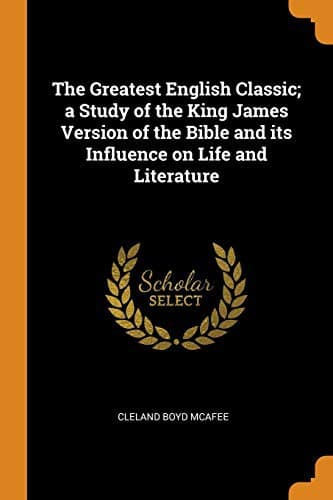
The Greatest English Classic: A Study of the King James Version of the Bible and Its Influence on Life and LiteratureMcAfee, Cleland Boyd
History
The Greatest English Classic: A Study of the King James Version of the Bible and Its Influence on Life and Literature
McAfee, Cleland Boyd
Bible -- History; Bible -- Influence; Bible and literature; Bible. English -- Versions -- Authorized
There are other signal events which might be
observed. But all the while there would be
danger of magnifying the importance of events
which seem to prove the point. The view needs
to be a more general one instead. The period
is not long--three hundred years at the most--
though it has a background of all English history.
We have already seen how from the first
there have been determined efforts to make the
Bible common to the people; yet, of course, the
influence of our version can appear only in these
three hundred years since it was issued. That
short period has not only been interesting almost
to the point of excitement in English life, but
it covers virtually all American life. Take,
therefore, the broader view of the influence of
the English Bible on history, apart from these
striking events.
It is to be assumed at once that much of its
influence is indirect. Indeed, its chief influence
must be through men who prove to be leaders
and through that public sentiment without which
leaders are powerless. If leaders live by it and
stand or fall by its teaching, then their work is
its work. If they find a public sentiment issuing
from it which gives them power, a sentiment
which crystallizes around them when they appear,
because it is of kindred spirit with themselves,
then the power of that sentiment is the power
of the Bible. The influence of Pilgrim's Progress
or The Saint's Rest is the influence of Bunyan
and Baxter; but back of them is the Bible. In
language, in idea, in spirit, they were only making
the Bible a common Book to their readers.
Their value for life and history is the Bible's
value for life and history.
The power of great souls is frequently and
easily underestimated. Scientific study has
tended to that by magnifying visible conditions
and by trying to calculate the force of
laws which are in plain sight. Buckle's theory
of civilization has influenced our times greatly.
It explains national character as the outcome of
natural conditions, and lays such stress on circumstances as left
it possible for Buckle to declare
that history and biography are in different
spheres. It is still true, however, that most
history turns on biography. Great souls have
been the chief factors in great movements.
Whether the movement could have occurred
without them will never be possible to decide,
if it should be disputed. In a chemical laboratory
the essential factors of any phenomenon
can be determined by the process of elimination.
All the elements which preceded it except one
can be introduced; if the result is the same as
in its presence, manifestly it is not essential.
So the experiment can go on until the result becomes
different, when it is evident that the last
omitted element is an essential one. But no
such process is possible in great historical movements.
The only course open to us is to consider
carefully the elements which do appear.
Public-domain text, read in full here on John Shaqi.
Reviews
Reviews
No reviews yet
Be the first to share your thoughts on this work.
Elsewhere in the archive
Join the Discussion
Join the discussion
Sign in to leave a comment or review.
Sign InorCreate an account