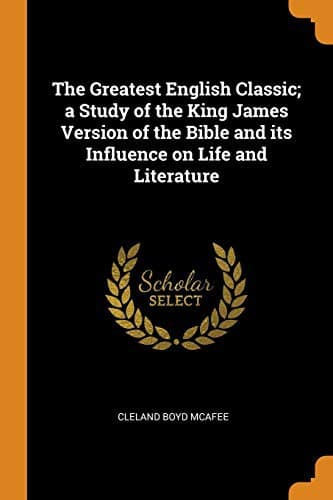
The Greatest English Classic: A Study of the King James Version of the Bible and Its Influence on Life and LiteratureMcAfee, Cleland Boyd
History
The Greatest English Classic: A Study of the King James Version of the Bible and Its Influence on Life and Literature
McAfee, Cleland Boyd
Bible -- History; Bible -- Influence; Bible and literature; Bible. English -- Versions -- Authorized
An English historian has said that the most
influential, the most unescapable years in English
history are those of the Protectorate. That
is a strong saying. They were brief years.
There were many factors in them. Oliver Cromwell
was only one, but he was chief of all. He
was not chief in the councils which resulted in
the beheading of Charles I. on that 30th of
January, 1649, though he took part in them.
Increasingly in the movements which led to
that event and which followed it he was growing
into prominence. After Marston Moor,
Prince Rupert named him Ironsides, and his
regiment of picked men, picked for their spirit,
went always into battle singing psalms, "and
were never beaten." As he rode out to the field
at Naseby (1645) he knew he faced the flower
of the loyalist army, while with him were only
untrained men; yet he smiled, as he said afterward,
in the "assurance that God would, by
things that are not, bring to naught things that
are." Then he adds, "God did it." Never
did he raise his flag but in the interests of the
liberty of the people, and back of every movement
of his army there was his confidence in the
Bible, which was his mainstay. They offered
him the throne; he would not have it. He dissolved
the Parliament which had dragged on
until the patience of the people was exhausted.
He called another to serve their need. The
evening before it met he spent in meditation on
the One hundred and third Psalm. The evening
before the second Parliament of his Protectorate
he brooded on the Eighty-fifth Psalm, and
opened the Parliament next day with an exposition
of it. The man was saturated with Scripture.
Yes, the times were rude. It was an Old
Testament age, and in right Old Testament
spirit did Cromwell work. And it seemed that
his work failed. There was no one to succeed
him, and soon after his death came the Restoration
and the return of Charles II., of which we
have already spoken, in which occurred that
hint of the real sentiment of the English people
which a wise man had better have taken.
Yet, recall what actually happened. Misunderstanding
the spirit of the English people, which
Cromwell had helped to form, but which in
turn had made Cromwell possible, the servile
courtiers of the false king unearthed the Protector's
body, three years buried, hanged it on
a gallows in Tyburn for a day, beheaded it, and
threw the trunk into a pit. His head they
mockingly set on a pinnacle of the Parliament
Hall, whence for some weeks it looked over the
city which he had served. Then, during a
great storm, it came clattering down, only a poor
dried skull, and disappeared no one knows where.
But when you stand opposite the great Parliament
buildings in London to-day, the most
beautiful buildings for their purpose in the world,
the buildings where the liberties of the English
express themselves year after year, whose is the
one statue that finds place within the inclosure,
near the spot where that poor skull came rattling
Public-domain text, read in full here on John Shaqi.
Reviews
Reviews
No reviews yet
Be the first to share your thoughts on this work.
Elsewhere in the archive
Join the Discussion
Join the discussion
Sign in to leave a comment or review.
Sign InorCreate an account