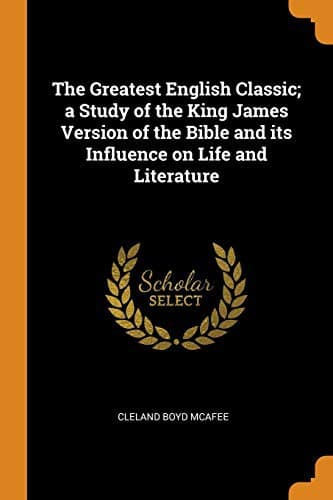
The Greatest English Classic: A Study of the King James Version of the Bible and Its Influence on Life and LiteratureMcAfee, Cleland Boyd
History
The Greatest English Classic: A Study of the King James Version of the Bible and Its Influence on Life and Literature
McAfee, Cleland Boyd
Bible -- History; Bible -- Influence; Bible and literature; Bible. English -- Versions -- Authorized
THIS lecture must differ at two points from
those which have preceded it. In the first
place, the other lectures have dealt entirely with
facts. This must deal also with judgments. In
the earlier lectures we have avoided any consideration
of what ought to have been and have
centered our interest on what actually did occur.
We especially avoided any argument based on
a theory of the literary characteristics or literary
influence of the Bible, but sought first to find
the facts and then to discover what explained
them. It might be very difficult to determine
what is the actual place of the Bible in the
life of to-day. Perhaps it would be impossible
to give a broad, fair judgment. It is quite certain
that the people of James's day did not
realize the place it was taking. It is equally
certain that many of those whom it most influenced
were entirely unconscious of the fact.
It is only when we look back upon the scene that
we discover the influence that was moving them.
But, while it is difficult to say what the place of
the Bible actually is in our own times, the place
it ought to have is easier to point out. That will
involve a study of the conditions of our times,
which suggest the need for its influence. While
we must consider the facts, therefore, we will be
compelled to pass some judgments also, and
therein this lecture must differ from the others.
The second fact of difference is that while the
earlier lectures have dealt with the King James
version, this must deal rather with the Bible.
For the King James version is not the Bible.
There are many versions; there is but one
Bible. Whatever the translators put into the
various tongues, the Bible itself remains the
same. There are values in the new versions;
but they are simply the old value of the Bible
itself. It is a familiar maxim that the newest
version is the oldest Bible. We are not making
the Bible up to date when we make a new version;
we are only getting back to its date. A
revision in our day is the effort to take out of
the original writings what men of King James's
day may have put in, and give them so much the
better chance. There is no revised Bible; there is
only a revised version. Readers sometimes feel
disturbed at what they consider the changes
made in the Bible. The fact is, the revision
which deserves the name is lessening the changes
in the Bible; it is giving us the Bible as it
actually was and taking from us elements which
were not part of it. One can sympathize with
the eloquent Dr. Storrs, who declared, in an
address in 1879, that he was against any new
version because of the history of the King James
version, describing it as a great oak with roots
running deep and branches spreading wide. He
declared we were not ready to give it up for any
modern tulip-tree. There is something in that,
though such figures are not always good argument.
Yet the value to any book of a worthy
translation is beyond calculation. The outstanding
literary illustration of that fact is
Public-domain text, read in full here on John Shaqi.
Reviews
Reviews
No reviews yet
Be the first to share your thoughts on this work.
Elsewhere in the archive
Join the Discussion
Join the discussion
Sign in to leave a comment or review.
Sign InorCreate an account