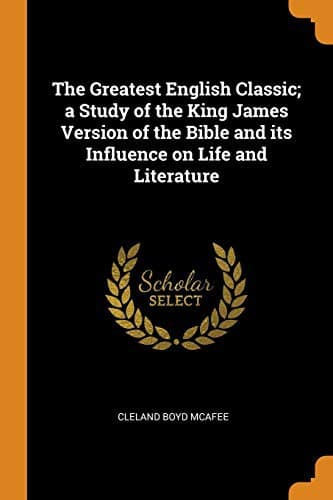
The Greatest English Classic: A Study of the King James Version of the Bible and Its Influence on Life and LiteratureMcAfee, Cleland Boyd
History
The Greatest English Classic: A Study of the King James Version of the Bible and Its Influence on Life and Literature
McAfee, Cleland Boyd
Bible -- History; Bible -- Influence; Bible and literature; Bible. English -- Versions -- Authorized
The third agency which needs to magnify the
Bible is the school. The accent which it will
choose will naturally be the literary value of the
Bible, though it will not overlook its moral
value as well. Incidental references heretofore
have suggested the importance of religion in a
democracy. But there are none of the great
branches of the teaching of the schools, public
or private, which do not involve the Bible. It
is impossible to teach history fairly and fully
without a frank recognition of the influence of
the Bible. Study the Reformation, the Puritan
movement, the Pilgrim journeys, the whole of
early American history! We can leave the Bible
out only by trifling with the facts. Certainly
literature cannot be taught without it. And if it
is the purpose of the schools to develop character
and moral life, then there is high authority for
saying that the Bible ought to have place.
Forty years ago Mr. Huxley, in his essay on
"The School Boards: What They Can Do, and
What They May Do," laid a broad foundation
for thinking at this point, and his words bear
quoting at some length: "I have always been
strongly in favor of secular education, in the
sense of education without theology; but I must
confess I have been no less seriously perplexed to
know by what practical measures the religious
feeling, which is the essential basis of conduct,
was to be kept up, in the present utterly chaotic
state of opinion on these matters, without the
use of the Bible. The pagan moralists lack life
and color, and even the noble stoic, Marcus
Aurelius Antoninus, is too high and refined for
an ordinary child. Take the Bible as a whole;
make the severest deductions which fair criticism
can dictate for shortcomings and positive
errors; eliminate, as a sensible lay teacher would
do if left to himself, all that is not desirable
for children to occupy themselves with; and there
still remains in this old literature a vast residuum
of moral beauty and grandeur. And then consider
the great historical fact that, for three centuries,
this Book has been woven into the life of
all that is best and noblest in English history;
that it has become the national epic of Britain,
and is as familiar to noble and simple, from
John-o'-Groat's House to Land's End, as Dante
and Tasso once were to the Italians; that it is
written in the noblest and purest English, and
abounds in exquisite beauties of mere literary
form; and, finally, that it forbids the veriest
hind who never left his village to be ignorant
of the existence of other countries and other
civilizations, and of a great past, stretching back
to the furthest limits of the oldest nations of the
world. By the study of what other book could
children be so much humanized and made to
feel that each figure in that vast historical procession fills,
like themselves, but a momentary
space in the interval between two eternities;
and earns the blessings or the curses of all time,
according to its effort to do good and hate evil,
Public-domain text, read in full here on John Shaqi.
Reviews
Reviews
No reviews yet
Be the first to share your thoughts on this work.
Elsewhere in the archive
Join the Discussion
Join the discussion
Sign in to leave a comment or review.
Sign InorCreate an account