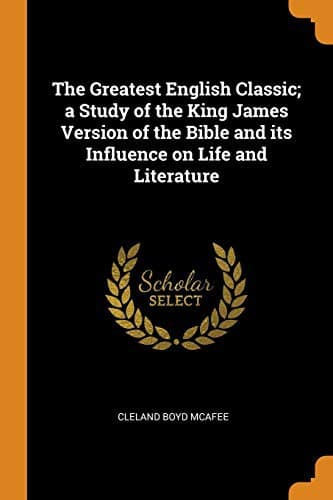
The Greatest English Classic: A Study of the King James Version of the Bible and Its Influence on Life and LiteratureMcAfee, Cleland Boyd
History
The Greatest English Classic: A Study of the King James Version of the Bible and Its Influence on Life and Literature
McAfee, Cleland Boyd
Bible -- History; Bible -- Influence; Bible and literature; Bible. English -- Versions -- Authorized
However, we may fairly make distinction between
the Bible as an original work and the
Bible as a work of English literature. For the
Bible as an original work is not so much a book
as a series of books, the work of many men working
separately over a period of at least fifteen
hundred years, and these men unconscious for
the most part of any purpose of agreement.
This series of books is made one book in the
original by the unity of its general purpose and
the agreement of its parts. The Bible in English
is, however, not a series of books, but properly
one book, the work of six small groups of
men working in conscious unity through a short
period of years. And while there is variation in
style, while there are inequalities in result, yet
it stands as a single piece of English literature.
It has a literary style of its own, even though
it feels powerfully the Hebrew influence throughout.
And while it would not be a condemnation
of the Bible if it were not great literature in
English or elsewhere, it is still part of its power
that by literary standards alone it measures
large.
It is so that men of letters have rated it since
it came into existence. "It holds a place of
pre-eminence in the republic of letters." When
John Richard Green comes to deal with it, he
says: "As a mere literary monument the English
version of the Bible remains the noblest language
of the English tongue, while its perpetual use
made of it from the instant of its appearance
the standard of our language."[1] And in Macaulay's
essay on Dryden, while he is deploring
the deterioration of English style, he yet says
that in the period when the English language
was imperiled there appeared "the English
Bible, a book which if everything else in our
language should perish would alone suffice to
show the extent of its beauty and power."
[1] Short History of the English People, Book vii, chap. i.
The mere fact that the English Bible contains
a religion does not affect its standing as literature.
Homer and Virgil are Greek and Roman
classics, yet each of them contains a definite
religion. You can build up the religious faith
of the Greeks and Romans out of their great
literature. So you can build up the religious
faith of the Hebrews and the early Christians
from the Old and New Testaments. "For fifteen
centuries a Hebrew Book, the Bible, contained
almost the whole literature and learning of a
whole nation," while it was also the book of
their religion.
Public-domain text, read in full here on John Shaqi.
Reviews
Reviews
No reviews yet
Be the first to share your thoughts on this work.
Join the Discussion
Join the discussion
Sign in to leave a comment or review.
Sign InorCreate an account