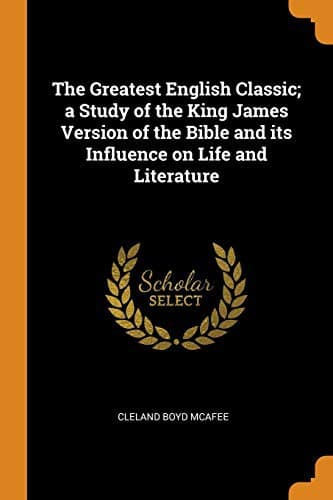
The Greatest English Classic: A Study of the King James Version of the Bible and Its Influence on Life and LiteratureMcAfee, Cleland Boyd
History
The Greatest English Classic: A Study of the King James Version of the Bible and Its Influence on Life and Literature
McAfee, Cleland Boyd
Bible -- History; Bible -- Influence; Bible and literature; Bible. English -- Versions -- Authorized
LET it be plainly said at the very first that
when we speak of the literary phases of
the Bible we are not discussing the book in its
historic meaning. It was never meant as literature
in our usual sense of the word. Nothing
could have been further from the thought of
the men who wrote it, whoever they were and
whenever they wrote, than that they were
making a world literature. They had the
characteristics of men who do make great literature--
they had clear vision and a great passion for
truth; they loved their fellows mightily, and
they were far more concerned to be understood
than to speak. These are traits that go to make
great writers. But it was never in their minds
that they were making a world literature. The
Bible is a book of religious significance from
first to last. If it utterly broke down by the
tests of literature, it might be as great a book
as it needs to be. It is a subordinate fact that
by the tests of literature it proves also to be
great. Prof. Gardiner, of Harvard, whose book
called The Bible as English Literature makes
other such works almost unnecessary, frankly
bases his judgment on the result of critical study
of the Bible, but he serves fair warning that he
takes inspiration for granted, and thinks it
"obvious that no literary criticism of the Bible
could hope for success which was not reverent
in tone. A critic who should approach it superciliously
or arrogantly would miss all that has
given the Book its power as literature and its
lasting and universal appeal."[1] Farther over
in his book he goes on to say that when we
search for the causes of the feelings which made
the marvelous style of the Bible a necessity,
explanation can make but a short step, for "we
are in a realm where the only ultimate explanation
is the fact of inspiration; and that is only
another way of saying that we are in the presence
of forces above and beyond our present
human understanding."[2]
[1] Preface, p. vii.
[2] Page 124.
Public-domain text, read in full here on John Shaqi.
Reviews
Reviews
No reviews yet
Be the first to share your thoughts on this work.
Join the Discussion
Join the discussion
Sign in to leave a comment or review.
Sign InorCreate an account