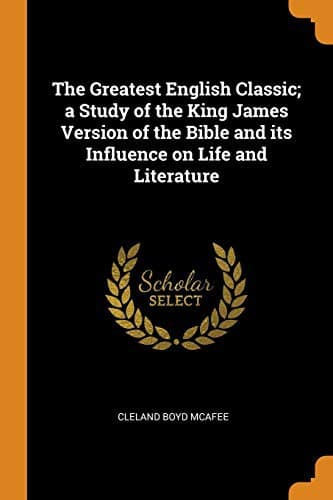
The Greatest English Classic: A Study of the King James Version of the Bible and Its Influence on Life and LiteratureMcAfee, Cleland Boyd
History
The Greatest English Classic: A Study of the King James Version of the Bible and Its Influence on Life and Literature
McAfee, Cleland Boyd
Bible -- History; Bible -- Influence; Bible and literature; Bible. English -- Versions -- Authorized
Many of us have seen a dozen books hailed
as classic novels sure to live, each of them the
great American novel at last, the author to be
compared with Dickens and Thackeray and
George Eliot. And the books have gone the
way of all the earth. With some, the trouble
is a weak, involved, or otherwise poor style.
With most the trouble is lack of real ideas.
Charles Dickens, to be sure, does deal with
boarding-schools in England, with conditions
which in their local form do not recur and are
not familiar to us; but he deals with them as
involving a great principle of the relation of
society to youth, and so David Copperfield or
Oliver Twist becomes a book for the life of all
of us, and for all time. And even here it is
evident that not all of Dickens's work will live,
but only that which is least narrowly local and
is most broadly human.
There is a further striking illustration in a
familiar event in American history. Most young
people are required to study Webster's speech
in reply to Robert Hayne in the United States
Senate, using it as a model in literary construction.
The speech of Hayne is lost to our interest,
yet the fact is that Hayne himself was
gifted in expression, that by the standards of
simple style his speech compares favorably with
that of Webster. Yet reading Webster's reply
takes one not to the local condition which was
concerning Hayne, but to a great principle of
liberty and union. He shows that principle
emerging in history; the local touches are lost
to thought as he goes on, and a truth is expressed
in terms of history which will be valid until
history is ended. It is not simply Webster's
style; it is that with his great idea which made
his reply memorable.
That neither ideas nor style alone can keep
literature alive is shown by literary history after
Shakespeare. Just after him you have the
"mellifluous poets" of the next period on the
one hand, with style enough, but with such
attenuated ideas that their work has died. Who
knows Drayton or Brown or Wither? On the
other hand, there came the metaphysicians with
ideas in abundance, but not style, and their
works have died.
Public-domain text, read in full here on John Shaqi.
Reviews
Reviews
No reviews yet
Be the first to share your thoughts on this work.
Join the Discussion
Join the discussion
Sign in to leave a comment or review.
Sign InorCreate an account