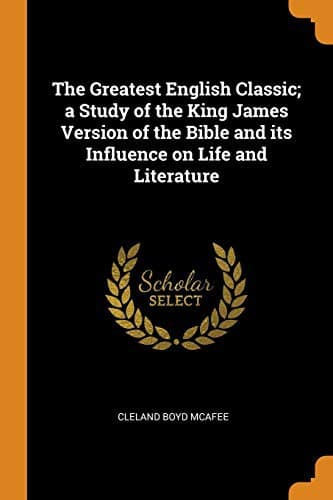
The Greatest English Classic: A Study of the King James Version of the Bible and Its Influence on Life and LiteratureMcAfee, Cleland Boyd
History
The Greatest English Classic: A Study of the King James Version of the Bible and Its Influence on Life and Literature
McAfee, Cleland Boyd
Bible -- History; Bible -- Influence; Bible and literature; Bible. English -- Versions -- Authorized
"Thou art love: the rich have kissed
Thy feet, and, like him following Christ,
Gave their substance to the free,
And through the rough world follow thee."
Page after page of Shelley reveals these half-
conscious references to the Bible. There were
two sources from which he received his passionate
democracy. One was the treatment he
received at Eton, and later at Oxford; the other
is his frequent reading of the English Bible, even
though he was in the spirit of rebellion against
much of its teaching. In Browning's essay on
Shelley, he reaches the amazing conclusion that
"had Shelley lived, he would finally have ranged
himself with the Christians," and seeks to justify
it by showing that he was moving straight toward
the positions of Paul and of David. Some
of us may not see such rapid approach, but that
Shelley felt the drawing of God in the universe
is plain enough.
The influence of the Bible is still more
marked on Byron. He spent his childhood years
at Aberdeen. There his nurse trained him in
the Bible; and, though he did not live by it, he
never lost his love for it, nor his knowledge of
it. He tells of his own experience in this way:
"I am a great reader of those books [the Bible],
and had read them through and through before
I was eight years old; that is to say, the Old
Testament, for the New struck me as a task,
but the other as a pleasure."[1] One of the earliest
bits of his work is a paraphrase of one of the
Psalms. His physical infirmity put him at odds
with the world, while his striking beauty drew
to him a crowd of admirers who helped to poison
every spring of his genius. Even so, he held
his love for the Bible. While Shelley often spoke
of it in contempt, while he prided himself on his
divergence from the path of its teaching, Byron
never did. He wandered far, but he always
knew it; and, though he could hardly find terms
to express his contempt for the Church, there
is no line of Byron's writing which is a slur
at the Bible. On the other hand, much of his
work reveals a passion for the beauty of it as
well as its truth. His most melodious writing
is in that group of Hebrew melodies which were
written to be sung. They demand far more
than a passing knowledge of the Bible both
for their writing and their understanding. There
is a long list of them, but no one without a
knowledge of the Bible would have known what he
meant by his poem, "The Harp the Monarch
Minstrel Swept." "Jephtha's Daughter" presumes
upon a knowledge of the Old Testament
story which would not come to one in a passing
study of the Bible. "The Song of Saul Before
his Last Battle" and the poem headed "Saul"
could not have been written, nor can they be read
intelligently by any one who does not know his
Bible. Among Byron's dramas, two of which
he thought most, were, "Heaven and Earth"
and "Cain." When he was accused of perverting
the Scripture in "Cain," he replied that he
had only taken the Scripture at its face value.
Public-domain text, read in full here on John Shaqi.
Reviews
Reviews
No reviews yet
Be the first to share your thoughts on this work.
Elsewhere in the archive
Join the Discussion
Join the discussion
Sign in to leave a comment or review.
Sign InorCreate an account