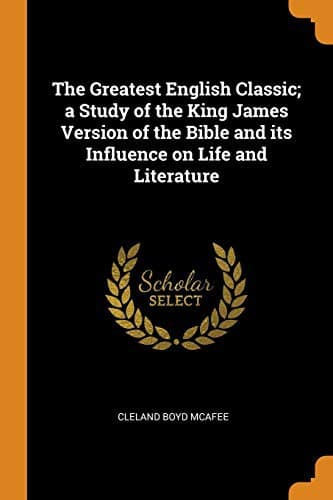
The Greatest English Classic: A Study of the King James Version of the Bible and Its Influence on Life and LiteratureMcAfee, Cleland Boyd
History
The Greatest English Classic: A Study of the King James Version of the Bible and Its Influence on Life and Literature
McAfee, Cleland Boyd
Bible -- History; Bible -- Influence; Bible and literature; Bible. English -- Versions -- Authorized
There are instances squarely in our own time
by which their mighty influence may be tested.
They are of books of almost ephemeral value
save for the student of history. As literature
they will be quickly forgotten; but as FORCES
they must be reckoned with. There is Uncle
Tom's Cabin. It would be absurd to say that
it brought the American Civil War, or freed
the negroes, or saved the Union. It did none
of those great things. Yet it is not at all absurd
to name it among the potent powers in all
three. It is not to our purpose whether it is
true or not as a statement of the whole fact.
Doubtless it was not true of the general and
common circumstances of Southern slavery; but
everything in it was possible, and even frequent
enough so that it could not be questioned. It
pretended no more. But its influence was simply
tremendous. In book form it became available
in 1852, and within three years, 1855, it
was common property of English-speaking people.
No other book ever produced so extraordinary
an effect so quickly in the public mind.[1]
It held up slavery to judgment. It crystallized
the thoughts of common people. The work of
those strenuous years in the '60's could not have
been done without the result of that book. It
made history. Come nearer our own day. We
could not be long in London without feeling
the concern of the better people for conditions
in the East End. A new social impulse has
seized them. To be sure, it lacks much yet of
success; but more has been done than most
people realize. The new movement, the awakening
of that social sense, traces back to the book
of Gen. William Booth, In Darkest England
(1890). It has helped to change the life of a
large part of London.
[1] Rhodes, History of the United States, vol. i, pp. 185-303.
On this side, the new concern for city conditions
dates from the book of a newspaper reporter,
Jacob A. Riis, How the Other Half Lives.
It thrust the Other Half into such prominence
that it has never been possible to forget it.
Marked advance in all American cities, in legislation
and life, goes straight back to it. Name
one other book still in the field of social service,
even so unpleasant, so terrible, so obnoxious a
book as Upton Sinclair's The Jungle. It started
and sustained movements which have unsettled
business and political life ever since it appeared.
It made some conditions vivid, unescapable.
Public-domain text, read in full here on John Shaqi.
Reviews
Reviews
No reviews yet
Be the first to share your thoughts on this work.
Elsewhere in the archive
Join the Discussion
Join the discussion
Sign in to leave a comment or review.
Sign InorCreate an account