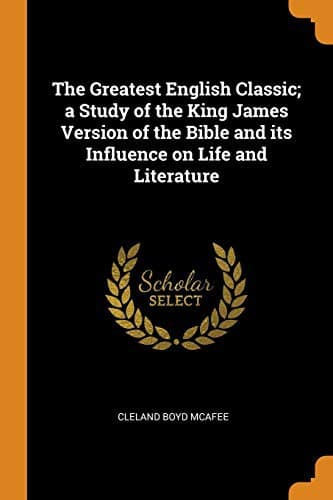
The Greatest English Classic: A Study of the King James Version of the Bible and Its Influence on Life and LiteratureMcAfee, Cleland Boyd
Religion
The Greatest English Classic: A Study of the King James Version of the Bible and Its Influence on Life and Literature
McAfee, Cleland Boyd
Bible -- History; Bible -- Influence; Bible and literature; Bible. English -- Versions -- Authorized
There are some who take all the Bible for granted. They know that there is
indifference to it among friends and in their social circle; but how real
the dispute about the Bible is no one realizes until he comes where new
ideas, say ideas of socialism, are in the air. There, with the breaking of
other chains, is a mighty effort to break this bond also. In such circles
the Bible is little read. It is discussed, and time-worn objections are
bandied about, always growing as they pass. In these circles also every
supposedly adverse result of critical study is welcomed and remembered. If
it is said that there are unexplained contradictions in the Bible, that
fact is remembered. But if it is said further that those contradictions
bid fair to yield to further critical study, or to a wiser understanding
of the situations in which they are involved, that fact is overlooked. The
tendency in these circles is to keep alive rather the adverse phases of
critical study than its favorable phases. Some of those who speak most
fiercely about the study of the Bible, by what is known as higher
criticism, are least intelligent as to what higher criticism actually
means. Believers regret it, and unbelievers rejoice in it. As a matter of
fact, in developing any strong feeling about higher criticism one only
falls a prey to words; he mistakes the meaning of both the words involved.
Criticism does not mean finding fault with the Bible.[52] It is almost an
argument for total depravity that we have made the word gain an adverse
meaning, so that if the average man were told that he had been
"criticized" by another he would suppose that something had been said
against him. Of course, intelligent people know that that is not
necessarily involved. When Kant wrote _The Critique of Pure Reason_ he was
not finding fault with pure reason. He was only making careful analytical
study of it. Now, critical study of the Bible is only careful study of it.
It finds vastly more new beauties than unseen defects. In the same way the
adjective "higher" comes in for misunderstanding. It does not mean
superior; it means more difficult. Lower criticism is the study of the
text itself. What word ought to be here, and exactly what does that word
mean? What is the comparative value of this manuscript over against that
one? If this manuscript has a certain word and that other has a slightly
different one, which word ought to be used?
Public-domain text, read in full here on John Shaqi.
Reviews
Reviews
No reviews yet
Be the first to share your thoughts on this work.
Elsewhere in the archive
Join the Discussion
Join the discussion
Sign in to leave a comment or review.
Sign InorCreate an account