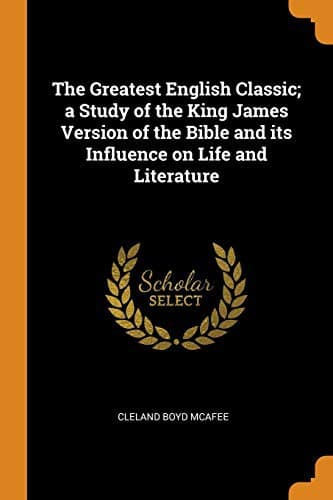
The Greatest English Classic: A Study of the King James Version of the Bible and Its Influence on Life and LiteratureMcAfee, Cleland Boyd
Religion
The Greatest English Classic: A Study of the King James Version of the Bible and Its Influence on Life and Literature
McAfee, Cleland Boyd
Bible -- History; Bible -- Influence; Bible and literature; Bible. English -- Versions -- Authorized
This applies to all the great classics. There has come about a "decay of
literary allusions," as one of our papers editorially says. In much of our
writing, either the transient or the permanent, men can no longer risk
easy reference to classical literature. "Readers of American biography
must often be struck with the important part which literary recollection
played in the life of a cultured person a generation or two ago. These men
had read Homer, Xenophon and Virgil, Shakespeare, Byron and Wordsworth,
Lamb, De Quincey and Coleridge. They were not afraid of being called
pedants because they occasionally used a Latin phrase or referred to some
great name of Greece or Rome." That is not so commonly true to-day.
Especially is there danger of losing easy acquaintance with the great
Bible references.
There are familiar reasons for it. For one thing, there has been a great
increase of literature. Once there was little to read, and that little
became familiar. One would have been ashamed to pretend to culture and not
to know such literature well. Now there is so much that one cannot know it
all, and most men follow the line of least resistance. That line is not
where great literature lies. Once the problem was how to get books enough
for a family library. Now the problem is how to get library enough for the
books. Magazines, papers, volumes of all grades overflow. "The Bible has
been buried beneath a landslide of books." The result is that the greatest
literary landmark of the English tongue threatens to become unknown, or
else to be looked upon as of antiquarian rather than present worth. There
our Puritan fathers had the advantage. As President Faunce puts it: "For
them the Bible was the norm and goal of all study. They had achieved the
concentration of studies, and the Bible was the center. They learned to
read that they might read the literature of Israel; their writing was
heavy with noble Old Testament phrases; the names of Old Testament heroes
they gave to their children; its words of immortal hope they inscribed on
their tombstones; its Mosaic commonwealth they sought to realize in
England and America; its decalogue was the foundation of their laws, and
its prophecies were a light shining in a dark place. Such a unification of
knowledge produced a unified character, simple, stalwart, invincible." It
is very different in our own day. As so-called literature increases it
robs great literature of its conspicuous outstanding character, and many
men who pride themselves on the amount they read would do far better to
read a thousandth part as much and let that smaller part be good.
Public-domain text, read in full here on John Shaqi.
Reviews
Reviews
No reviews yet
Be the first to share your thoughts on this work.
Elsewhere in the archive
Join the Discussion
Join the discussion
Sign in to leave a comment or review.
Sign InorCreate an account