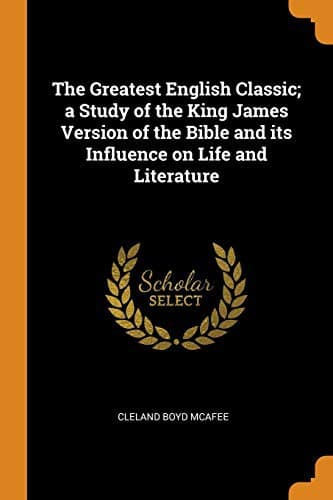
The Greatest English Classic: A Study of the King James Version of the Bible and Its Influence on Life and LiteratureMcAfee, Cleland Boyd
Religion
The Greatest English Classic: A Study of the King James Version of the Bible and Its Influence on Life and Literature
McAfee, Cleland Boyd
Bible -- History; Bible -- Influence; Bible and literature; Bible. English -- Versions -- Authorized
From an ethical point of view, "the ethical content of Paul is quite as
important for us as the system of Schopenhauer or Nietzsche. The
organization of the New England town meeting is no more weighty for the
American boy than the organization of the early Christian Church. John
Adams and John Hancock and Abraham Lincoln are only the natural
successors of the great Hebrew champions of liberty and righteousness who
faced Pharoah and Ahab and put to flight armies of aliens." But aside from
the definite ethical teaching of the Bible there is need for that strong
impression of ethical values which it gives in the characters around which
it has gathered. The conception of the Bible which makes it appear as a
steady progression should add to its authority, not take from it. The
development is not from error to truth, but from light to more light. It
is sometimes said that the standards of morality of some parts of
Scripture are not to be commended. But they are not the standards of
morality of Scripture, but of their times. They are not taught in
Scripture; they are only stated; and they are so stated that instantly a
thoughtful man discovers that they are stated to be condemned. When did it
become true that all that is told of a good man is to be approved? It is
not pretended that Abraham did right always. David was confessedly wrong.
They move much of the time in half-light, yet the sum total of the
impression of their writings is inevitably and invariably for a more
substantial morality. These times need the moral steadying of the Bible to
make men, not creatures of the day and not creatures of their whims, but
creatures of all time and of fundamental laws.
Add the third fact, that our times have and still need the religious
influence of the Bible. No democracy can dispense with religious culture.
No book makes for religion as does the Bible. That is its chief purpose.
No book can take its place; no influence can supplant it. Max Muller made
lifelong study of the Buddhist and other Indian books. He gave them to the
English-speaking world. Yet he wrote to a friend of his impression of the
immense superiority of the Bible in such terms that his friend replied:
"Yes, you are right; how tremendously ahead of other sacred books is the
Bible! The difference strikes one as almost unfairly great."[56] Writing
in an India paper, _The Kayestha Samachar_, in August, 1902, a Hindu
writer said: "I am not a Christian; but half an hour's study of the Bible
will do more to remodel a man than a whole day spent in repeating the
slokas of the Purinas or the mantras of the Rig-Veda." In the earlier
chapters of the Koran Christians are frequently spoken of as "people of
the Book." It is a suggestive phrase. If Christianity has any value for
American life, then the Bible has just that value. Christianity is made
by the Bible; it has never been vital nor nationally influential for good
without the Bible.
Public-domain text, read in full here on John Shaqi.
Reviews
Reviews
No reviews yet
Be the first to share your thoughts on this work.
Elsewhere in the archive
Join the Discussion
Join the discussion
Sign in to leave a comment or review.
Sign InorCreate an account