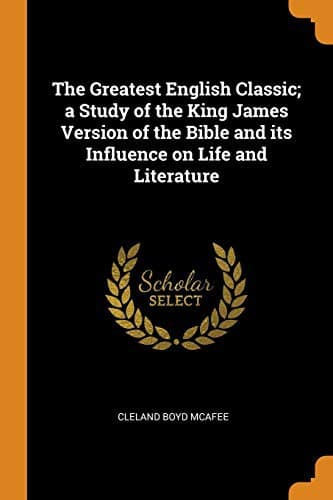
The Greatest English Classic: A Study of the King James Version of the Bible and Its Influence on Life and LiteratureMcAfee, Cleland Boyd
Religion
The Greatest English Classic: A Study of the King James Version of the Bible and Its Influence on Life and Literature
McAfee, Cleland Boyd
Bible -- History; Bible -- Influence; Bible and literature; Bible. English -- Versions -- Authorized
A moment ago it was said that as a piece of literature the Bible must
accept the standards of other literary books. For all present purposes we
can define great literature as worthy written expression of great ideas.
If we may take the word "written" for granted, the rough definition
becomes this: that great literature is the worthy expression of great
ideas. Works which claim to be great in literature may fail of greatness
in either half of that test. Petty, local, unimportant ideas may be well
clothed, or great ideas may be unworthily expressed; in either case the
literature is poor. It is not until great ideas are wedded to worthy
expression that literature becomes great. Failure at one end or the other
will explain the failure of most of the work that seeks to be accounted
literature. The literary value of a book cannot be determined by its style
alone. It is possible to say nothing gracefully, even with dignity,
symmetry, rhythm; but it is not possible to make literature without ideas.
Abiding literature demands large ideas worthily expressed. Now, of course,
"large" and "small" are not words that are usually applied to the
measurement of ideas; but we can make them seem appropriate here. Let us
mean that an idea is large or small according to its breadth of interest
to the race and its length of interest to the race. If there is an idea
which is of value to all the members of the human race to-day, and which
does not lose its value as the generations come and go, that is the
largest possible idea within human thought. Transient literature may do
without those large ideas. A gifted young reporter may describe a dog
fight or a presidential nominating convention in such terms as lift his
article out of carelessness and hasty newspaper writing into the realm of
real literature; but it cannot become abiding literature. It has not a
large enough idea to keep it alive. And to any one who loves worthy
expression there is a sense of degradation in the use of fine literary
powers for the description of purely transient local events. It is always
regrettable when men with literary skill are available for the description
of a ball game, or are exploited as worthy writers about a prize-fight. If
a man has power to express ideas well, he ought to use that power for the
expression of great ideas.
Public-domain text, read in full here on John Shaqi.
Reviews
Reviews
No reviews yet
Be the first to share your thoughts on this work.
Join the Discussion
Join the discussion
Sign in to leave a comment or review.
Sign InorCreate an account