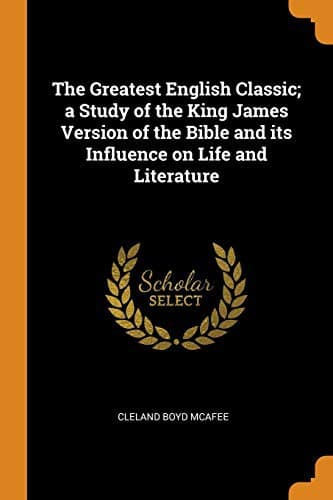
The Greatest English Classic: A Study of the King James Version of the Bible and Its Influence on Life and LiteratureMcAfee, Cleland Boyd
Religion
The Greatest English Classic: A Study of the King James Version of the Bible and Its Influence on Life and Literature
McAfee, Cleland Boyd
Bible -- History; Bible -- Influence; Bible and literature; Bible. English -- Versions -- Authorized
There is no need of much word on the spell of the Bible over Robert
Browning and Mrs. Browning. It is not often that two singing-birds mate;
but these two sang in a key pitched for them by the Scripture as much as
by any one influence. Many of their greatest poems have definite Biblical
themes. In them and in others Biblical allusions are utterly bewildering
to men who do not know the Bible well. For five years (1841-1846)
Browning's poems appeared under the title _Bells and Pomegranates_. Scores
of people wondered then, and wonder still, what "Pippa Passes" and "A Blot
in the Scutcheon" and the others have to do with such a title. They have
never thought, as Browning did, of the border of the beautiful robe of the
high priest described in the Book of Exodus. The finest poem of its length
in the English language is Browning's "Saul"; but it is only the story of
David driving the evil spirit from Saul, sweeping on to the very coming of
Christ. "The Death in the Desert" is the death of John, the beloved
disciple. "Karshish, the Arab Physician" tells in his own way of the
raising of Lazarus. The text of "Caliban upon Setebos" is, "Thou
thoughtest that I was altogether such an one as thyself." The text of
"Cleon" is, "As certain of your own poets have said." In "Fifine at the
Fair" the Curé expounds the experience of Jacob and his stone-pillow with
better insight than some better-known expositors show. In "Pippa Passes,"
when Bluphocks, the English vagabond, is introduced, Browning seems to
justify his appearance by the single foot-note: "He maketh His sun to rise
on the evil and on the good, and sendeth rain on the just and on the
unjust"; and Mr. Bluphocks shows himself amusingly familiar with Bible
facts and phrases. Mr. Sludge, "the Medium," thinks the Bible says the
stars are "set for signs when we should shear sheep, sow corn, prune
trees," and describes the skeptic in the magic circle of spiritual
"investigators" as the "guest without the wedding-garb, the doubting
Thomas." Some one has taken the trouble to count five hundred Biblical
phrases or allusions in "The Ring and the Book." Mrs. Browning's "Drama of
Exile" is the woman's side of the fall of Adam and Eve. Ruskin thought her
"Aurora Leigh" the greatest poem the century had produced at that time. It
abounds in Scriptural allusions. Browning came by all this naturally.
Raised in the Church by a father who "delighted to surround him with
books, notably old and rare Bibles," and a mother Carlyle called "a true
type of a Scottish gentlewoman," with all the skill in the Bible that that
implies, he never lost his sense of the majesty of the movement of
Scripture ideas and phrases.
Public-domain text, read in full here on John Shaqi.
Reviews
Reviews
No reviews yet
Be the first to share your thoughts on this work.
Elsewhere in the archive
Join the Discussion
Join the discussion
Sign in to leave a comment or review.
Sign InorCreate an account