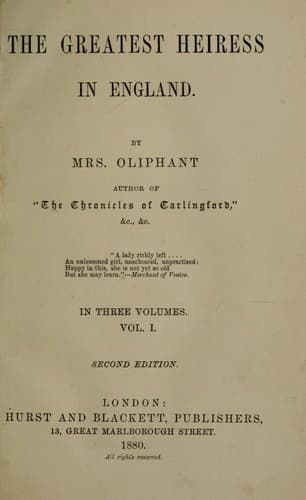
The Greatest Heiress in EnglandOliphant, Mrs. (Margaret)
General
The Greatest Heiress in England
Oliphant, Mrs. (Margaret)
England -- Fiction; Inheritance and succession -- Fiction
“Of course there will be fortune-hunters after her. He ought,” said the
rector, who was given to laying down the law, “to have appointed a
couple of trustworthy guardians, as other people do, and left it in
their hands. Such an arrangement as this, no one can help seeing, is
positively absurd.”
Here Ford cleared his throat expressively, with a sound which drew all
eyes toward him. But the good man, having thus protested inarticulately,
was shy, and shrunk from speech. He retreated a step or two with
involuntary precipitation. And the only defender old Trevor found was in
Mr. Williamson, who, nevertheless, had no desire to pit himself against
the rector: he would have liked, on the contrary, to be liberal and
friendly, and to show himself superior to all petty feeling; but he
could not help taking a special interest in everything his clerical
brother, who did not admit his brotherhood, did or said. Opposition or
friendship, it might be either one or the other, but indifference could
not be between them. Accordingly, as soon as the rector had said
anything, Mr. Williamson was instantly moved to say the reverse.
“We must not forget,” he said, putting down his hat on the floor, “that
our late lamented friend was carried out of this place only to-day. To
call his arrangements absurd so soon is surely, if I may say so, not in
good taste.”
“Oh, as for good taste--” cried the rector imperatively, with a sneer
upon his lips; but he stopped himself in time. He would not get into any
altercation, he said to himself; it was bad enough to be confronted with
Dissenters, to have one of these fanatics actually sitting down with
him at the same table, but to suffer himself to be led into a
controversy! “As for that,” he said, “my mind is easy enough. But here
is a very simple question--”
“Shall you serve, Dr. Beresford, or do you decline it?” Mr. Rushton
said.
This was a question more simple still. The rector turned round and
stared at the other with a confused and bewildered countenance. This was
not at all what he meant. He paused for a moment, and reflected before
he made any answer: would he serve, or did he decline it? Very simple,
but not so easy to answer: would he have a finger in the pie, or give it
up altogether? would he accept the mysterious position, and keep the
dear privilege of control, and the power of saying who was not to marry
Lucy Trevor, though he cared little for Lucy Trevor, or would he show
his sense of the folly of the arrangement by rejecting any share in it?
It was, though so simple, a difficult question, much more difficult than
to set down the old man, who was not a Churchman, as a fool. It did not
please him, however, to accept the latter alternative; he was a man who
dearly liked to have a finger in every pie.
“Oh, ah! indeed! yes, to be sure. That is how you put it,” he said.
Public-domain text, read in full here on John Shaqi.
Reviews
Reviews
No reviews yet
Be the first to share your thoughts on this work.
Elsewhere in the archive
Join the Discussion
Join the discussion
Sign in to leave a comment or review.
Sign InorCreate an account