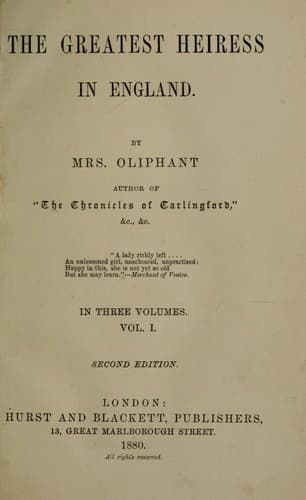
The Greatest Heiress in EnglandOliphant, Mrs. (Margaret)
General
The Greatest Heiress in England
Oliphant, Mrs. (Margaret)
England -- Fiction; Inheritance and succession -- Fiction
“I don’t know this gentleman, my dear,” she said, “and I don’t doubt he
is very kind; but I am sure it would be mistaken kindness to separate
these two poor children now. Just after one great loss, she is not in a
fit state to bear another wrench. No. I don’t know who Jock is, and I
have not much room in my little house; but you shall have your Jock, my
dear. I will not be the one to take him from you,” Lady Randolph said.
This was a thing which no one had so much as thought of. They all gazed
at her with wonder and admiration, while Lucy, in the sudden relief,
fell a-crying, more subdued and broken down than she had yet shown
herself. While the girl was being caressed and soothed, Mrs. Stone went
away, finding no room for her own ministrations. She said, “That is a
very clever woman,” to Philip Rainy at the door.
CHAPTER XVIII.
THE NEW LIFE.
Lady Randolph made haste to strike while the iron was hot. She _was_ a
clever woman, conscious enough (though, perhaps, no more than other
people) of her own interests, and with schemes in her mind (as everybody
had) of other interests to be served through the heiress, whom it had
been one of the successes of her later life to obtain the charge of;
but, having got this, she had no other intention than to treat Lucy
kindly, and to make her life, which would add so many comforts to Lady
Randolph’s, pleasant and happy to herself. The best way to do this was
to win the girl’s heart. Lady Randolph had not been seized with love at
first sight for her new charge; but she was rather prepossessed than
otherwise by Lucy’s appearance, and she was anxious to get hold of her
and secure her affections with as little delay as possible; and when she
informed Mrs. Ford, as she sipped the cup of tea which that excellent
woman prepared for her, that she was going to pass the night at the
Hall, and that to return to that scene of her happier life was always “a
trial” to her, she had already touched a chord of sympathy in Lucy’s
heart.
“What I should like,” Lady Randolph said, “would be that you should come
with me, my dear. It would be a great matter for me. The Hall belongs to
Sir Thomas now, my nephew, you know. He is very kind to me, and I look
upon him almost as a son, and his house is always open to me; but when
you remember that I was once mistress there, and spent a happy life in
it, and that now I am all alone, meeting ghosts in every room--”
Lucy’s heart came to her eyes. It was all true that Lady Randolph said,
but perhaps no such statement, made for the purpose of calling forth
sympathy, ever achieves its end without leaving a certain sense of
half-aroused shame in the mind of the successful schemer. Lady Randolph
was touched by the warmth of feeling in the girl’s eyes, and she was
half ashamed of herself for the conscious exaggeration which had called
it forth. Mrs. Ford was very sympathetic.
Public-domain text, read in full here on John Shaqi.
Reviews
Reviews
No reviews yet
Be the first to share your thoughts on this work.
Elsewhere in the archive
Join the Discussion
Join the discussion
Sign in to leave a comment or review.
Sign InorCreate an account