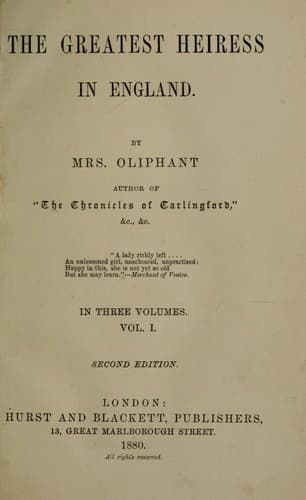
The Greatest Heiress in EnglandOliphant, Mrs. (Margaret)
General
The Greatest Heiress in England
Oliphant, Mrs. (Margaret)
England -- Fiction; Inheritance and succession -- Fiction
Her shyness had melted away under the kind looks of her
new friend; Lucy was too composed to be very shy by nature, but even the
silence was not embarrassing to her, which is the greatest test of all.
It was easy after that to go on to talk of herself a little. Lady
Randolph had become honestly interested in her young companion; Lucy was
in every way so much better than she had expected. Even the hand which
she had taken into her own was, now she had time to think of it, an
agreeable surprise. Lucy’s hand was small and soft, and as prettily
shaped as if she had been born a princess. These indications of race,
which are so infallible in romance, do not always hold in actual life.
The old school-master’s daughter had no beauty to speak of; but her hand
was as delicate as if the bluest blood in the world ran in her veins.
Lady Randolph felt that Providence had been very good to her in this
respect, for, indeed, she could not but feel that a large red coarse
hand was what might have been expected in the little _parvenue_. But
Lucy was not coarse in any particular; she would never come to the pitch
of refinement which that princess reached who felt a pea through fifteen
mattresses; but her quiet straightforwardness could never be vulgar.
This certainty relieved her future chaperon from her worst fears.
“My house is not like this,” Lady Randolph said; “London houses are
small; but I try to make it comfortable. I have partly arranged your
rooms for you; but I have left you all the finishing touches. It will
amuse you to settle your pretty things about you yourself.”
“I have not any pretty things,” said Lucy; “I have nothing but--” Jock,
she was going to say; but she was not sure of the prudence of the
speech, seeing Jock was her grand difficulty in life.
“Never mind,” said Lady Randolph, “nothing can be easier than to get
them; and you must have a maid--unless indeed there is one that you
would like to bring with you. I should prefer a new one, a stranger who
would not make any comparisons, who would easily fall into the ways of
my house.”
“I have no one,” said Lucy, eagerly; “I have never been accustomed to
anything of the kind. I never had a maid in my life.”
“Well, my dear, it has not been a very long life. We must find you a
nice maid. Of course you will not go out this year; but there will be
plenty of things to interest you. Are you very fond of music? or
anything else? You must tell me what you like best.”
“I can play--a little, Lady Randolph, not anything to speak of,” said
Lucy, with the instinct of a school-girl. She did not even think of
music in any higher sense.
“Then that is not your _spécialité_; have you a _spécialité_, Lucy?
Perhaps it is art?”
“I can draw--a very little, Lady Randolph.”
Lucy’s questioner laughed. “Then I am in hopes,” she said, “great
hopes, that you are a real, honest, natural, ignorant girl, like what we
used to be. Don’t say you are scientific, Lucy; I could not understand
that.”
Public-domain text, read in full here on John Shaqi.
Reviews
Reviews
No reviews yet
Be the first to share your thoughts on this work.
Elsewhere in the archive
Join the Discussion
Join the discussion
Sign in to leave a comment or review.
Sign InorCreate an account