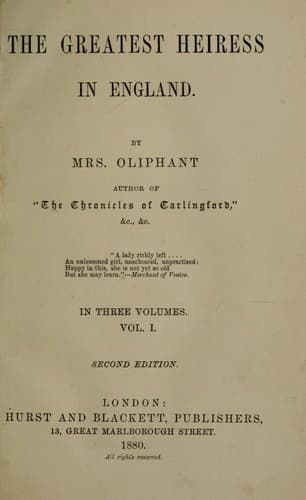
The Greatest Heiress in EnglandOliphant, Mrs. (Margaret)
General
The Greatest Heiress in England
Oliphant, Mrs. (Margaret)
England -- Fiction; Inheritance and succession -- Fiction
sleeve, talking to her, and keeping the rest of her friends waiting.
When she did get to the carriage at last it was through a tumult of
leave-takings, which made the very guards and porters tearful. Mrs. Ford
stood crying, saying, “God bless you!” at intervals; and Mrs. Stone
folded her pupil in a close embrace. “Remember, Lucy, that you are
coming back in six months, according to your good father’s will; and I
hope you will not have forgotten your old friends,” she said, with a
mixture of affection and authority. Mr. St. Clair stood with his hat
off, smiling and bowing. “May I say good-bye, too? And good luck!” he
said, enveloping Lucy’s black glove in his large soft white hand. He was
the tallest and the biggest there, and that always makes an impression
upon a girl’s imagination. Then the Rushtons came forward and took her
into their group. “I felt that I must come to give you my very best
wishes,” Mrs. Rushton said; “and here is Raymond, your old playfellow,
who hopes you remember him, Lucy. He only came home last night, but he
would come to see you off.” Then the girls all rushed at their comrade,
whom they all envied, though some of them were sorry for her. “You will
be sure to write,” they cried, with one voice and a succession of hugs.
“And, oh, Lucy!” cried Katie Russell, “please go and see mamma!” It was
with difficulty that she was helped into the carriage after all these
encounters, a little disheveled; smiling and crying, and with Jock all
hidden and wound up in her skirts. But the person who extricated her and
put her into the carriage was Philip, who held steadily to his superior
rights. He was the last to touch her hand, and he said, “Remember!” as
the train began to move, as solemnly as did the solemn king on the
scaffold. This cost Philip more than one dinner-party, and may almost be
said to have damaged his prospects at Farafield. “Did you ever see such
presumption,” Mrs. Rushton said, “pushing in before you, her guardian?”
And he was not asked to the Rushtons for a long time after, not till
they were in absolute despair for a stray man to fill a corner. It was
like the dispersion of a congregation from some special service to see
all the people streaming away. And Lucy was the subject of a hundred
fears and doubts. They shook their heads over her, all but the
school-girls, who thought it would be too delightful to be Lucy. It was
thus that Lucy set out upon the world.
CHAPTER XIX.
LADY RANDOLPH’S MOTIVE.
Public-domain text, read in full here on John Shaqi.
Reviews
Reviews
No reviews yet
Be the first to share your thoughts on this work.
Elsewhere in the archive
Join the Discussion
Join the discussion
Sign in to leave a comment or review.
Sign InorCreate an account