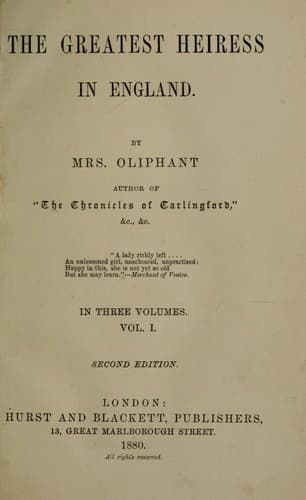
The Greatest Heiress in EnglandOliphant, Mrs. (Margaret)
General
The Greatest Heiress in England
Oliphant, Mrs. (Margaret)
England -- Fiction; Inheritance and succession -- Fiction
Was it true? Lady Randolph was very angry and impatient as she turned
from the door, after the kiss which she had bestowed on each. Women have
to kiss, as men shake hands, it is the established formula of parting
among friends, not to be omitted, which would imply a breach, because of
a little momentary flash of irritation. But the cause of her anger was
not so much what they had said to her as that word of mutual confidence
which she knew would pass between them at the door: was it true? If it
had not been so Lady Randolph would not have divined it. She paced up
and down her pretty drawing-room, giving one glance from the window to
see, as she expected, the one lady standing at the door of the little
carriage, while the wrinkled countenance of the other bent out from
within. She saw Lady Betsinda give a great many nods of intelligence,
and her heart burned within her with momentary fury. Often it happens
that the worst of the pang of being found out is the revelation it makes
to one’s self. Lady Randolph meant no harm; not to introduce her nephew
to Lucy would have been, in the circumstances, a thing impossible; and
who could expect her to be responsible for anything that might follow?
When an unmarried man meets a nice girl there is never any telling what
may happen. And Lucy was certainly a nice girl, notwithstanding her
ignorance and simplicity and her great fortune. To be sure, any
connection of this kind would be a _mésalliance_ for Tom; but even these
were common incidents, and took place in the very highest circles. If
this was fortune-hunting, then fortune-hunting was simple nature, and no
more. After awhile the irritation died away. She sat down again and took
up the book she had been reading when that committee of direction came
in and began their sitting upon her and her concerns. Lady Randolph was
about sixty, a large and ample woman with no pretense at juvenility; but
her eye was not dim or her natural force abated. There was only a small
proportion of gray--just enough to give it an air of honest reality--in
her abundant hair. As she sat and read a sentence or two, then paused
and mused a little with the book closed over her hand, she recovered her
composure. “What good will it do _me_?” she asked herself triumphantly.
Had she been seeking her own advantage her conduct might have been
subject to blame; but she was not seeking her own advantage. Should any
marriage come to pass it would deprive her, at one stroke, of all the
comfort which Lucy’s allowance brought her. She would be giving up, not
gaining anything. When this thought passed through her mind it seemed a
full answer to all possible objections, and she resumed her reading with
the feeling that she had put every caviller to silence, and nobly
justified herself to herself. “What advantage would it be to me?” the
words twined themselves among those of the book she was reading, and
appeared on every page more visible than the print. “What good would it
Public-domain text, read in full here on John Shaqi.
Reviews
Reviews
No reviews yet
Be the first to share your thoughts on this work.
Elsewhere in the archive
Join the Discussion
Join the discussion
Sign in to leave a comment or review.
Sign InorCreate an account