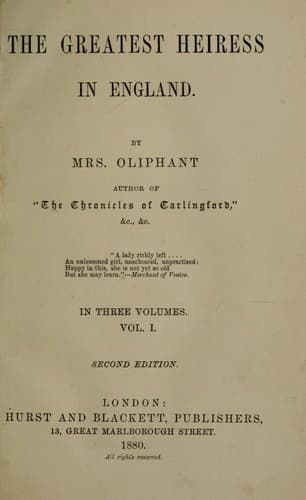
The Greatest Heiress in EnglandOliphant, Mrs. (Margaret)
General
The Greatest Heiress in England
Oliphant, Mrs. (Margaret)
England -- Fiction; Inheritance and succession -- Fiction
“Ah, my dear, if I may call you so,” cried the poor woman with the
headache, “that is the very sweetest thing you could say,” but all the
same her eyes kept questioning. What had the heiress come for? What had
Lady Randolph come for? When visitors like these enter a very poor
house, should not some pearls and diamonds fall from their lips, some
little wells of comforting wealth spring up beneath their feet?
“How does the school go on?” said Lady Randolph; “that is the cause of
our visit, really. I heard of a little boy--but how does it go on? Did
you settle about those Indian children?”
“Ah,” said Mrs. Russell, “there is nothing so hard to get as Indian
children; they are the prizes; if one can but get a good connection in
that way, one’s fortune is made; but there are so many that want them.
It seems to me that there is nothing in all the world but a crowd of
poor ladies fighting for pupils. It will be strange to you, Miss Trevor,
to hear any one talk like that,” she added.
She could not help, it would seem, this reference to Lucy; a girl who
was made of money, who could support dozens of families and never feel
it. It was not that the poor lady wanted her money, but she could not
help feeling a wistful wonder about her, a young creature whose fate was
so different! When one is very poor it is so natural to admire wealth,
and so curious to see it, and watch its happy owners, if only to note in
what way they differ. Lucy did not differ in any way, at which poor Mrs.
Russell admired and wondered all the more.
“But you have some pupils?” Lady Randolph said.
“Yes, three in the house, and six who are day-scholars. Bertie tells me
it is not such a bad beginning. I tried for little boys, because there
are so few, in comparison, that take little boys; and Bertie teaches
them Latin.”
“I thought your son was to get a situation.”
“Yes, indeed, but some one else got it instead; one can hardly grudge
it, when one knows how many poor young fellows there are with nothing.
He is writing,” Mrs. Russell said, with some pride.
“Writing!” Lady Randolph echoed with dismay, mingled with contempt.
Their points of view were very different. To the mother, fortune seemed
to be hovering, doubtful, yet very possible, over the feather of her
boy’s pen; to the woman of the world, a little clerkship in an office
would have been much more satisfactory. “You should not encourage him
in that; I fear it is not much better than idleness,” Lady Randolph
said, shaking her head.
“Idleness! look at Mr. Trollope, and all those gentlemen; it is a fine
profession! a noble profession!” said the poor lady fervently; but she
added, with a sigh, “if he could only get an opening, that is the hard
thing. If he only knew somebody! Bertie takes the Latin, and Mary the
English, and I superintend, and give the music lessons.”
“And you are getting on?”
Public-domain text, read in full here on John Shaqi.
Reviews
Reviews
No reviews yet
Be the first to share your thoughts on this work.
Elsewhere in the archive
Join the Discussion
Join the discussion
Sign in to leave a comment or review.
Sign InorCreate an account