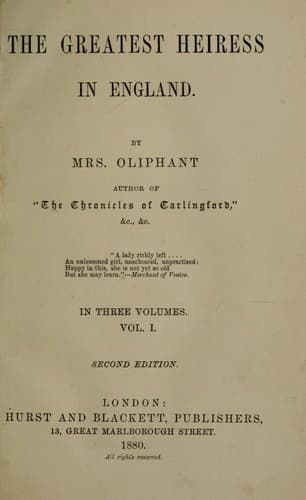
The Greatest Heiress in EnglandOliphant, Mrs. (Margaret)
General
The Greatest Heiress in England
Oliphant, Mrs. (Margaret)
England -- Fiction; Inheritance and succession -- Fiction
He had thought money was everything, but it was not what he thought.
Lucy was glad that she had not written to Mr. Chervil about it as she
had intended, for most likely he would have laughed at her, or perhaps
been angry. Evidently the only thing for her to do was to “read,” as
Lady Randolph advised her, and try to learn German, and keep as quiet as
possible. It was dull, very dull, without Jock, but Lucy was of a
patient disposition, and reconciled herself gradually to her life.
On the whole, however, this life was a life full of pleasantness to
which the most exacting young person might easily have reconciled
herself. Lady Randolph was very kind--indeed, as time went on, she got
to like Lucy very sincerely, appreciating the good qualities of a girl
who brought so much into the establishment and took so little out, who
gave no trouble at all, as the servants said, rather despising her for
it. But Lady Randolph did not despise her. She knew the value of a
companion who was always contented, and aspired after no forbidden
pleasures of society, and did not so much as understand the A B C of
flirting. Such a girl was of rare occurrence in the world, or, at least,
so persons of experience, accustomed to think the worst of all classes
of their fellow-creatures, said. A girl who was always willing to do
what she was told, and who set up no will of her own, and had no
confidential visitor, except Mr. Chervil, who was one of her legal
guardians, was a charge with whom any chaperon might be pleased;
provided all went as well next year, when Lucy came out; but Lady
Randolph piously reflected that no one could tell what might happen
before that. Lucy excited no strong feeling: there was little in her
(except her fortune) to take hold of the imagination; but her quiet
presence was always soothing and pleasant. Lady Randolph professed to go
little into society that season, “saving herself up,” as she said, for
the next, when it would be her more arduous duty to take Lucy out. But
though she did not go out much, that did not prevent her from enjoying a
great many dinner-parties, and even occasionally “looking in” upon some
dear duchess’s ball; and Lucy spent many quiet evenings at home, in
which her chief amusement was to hear the carriages of the people who
were enjoying themselves roll up and down the street, and in wondering
how she would like it next year, when she would be enjoying herself too.
She did not at all dislike these quiet evenings, and, on the whole, her
life passed very pleasantly as the spring grew into summer, and the
season came to its prime. She rode in the morning, sometimes in the
park, when Lady Randolph could find suitable companions for her, and
often going as far as Hampstead, where Mary Russell looked out upon her
from the school-room window with cheerful friendliness; and Bertie, not
very sure of his skill, came out to put her on her horse when she was
ready to go, and bit his young mustache with envy and anger against
Public-domain text, read in full here on John Shaqi.
Reviews
Reviews
No reviews yet
Be the first to share your thoughts on this work.
Elsewhere in the archive
Join the Discussion
Join the discussion
Sign in to leave a comment or review.
Sign InorCreate an account