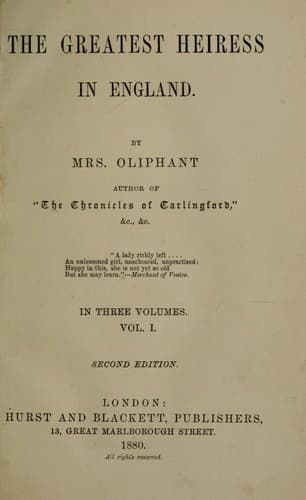
The Greatest Heiress in EnglandOliphant, Mrs. (Margaret)
General
The Greatest Heiress in England
Oliphant, Mrs. (Margaret)
England -- Fiction; Inheritance and succession -- Fiction
The young man stood and looked after Lucy, waiting to wave his hand to
her as she turned the corner. She looked very well on horseback. If he
had not felt that indignant envy of her, that sense that a trumpery bit
of a girl had no right to be so much better off than he, he would have
almost admired Lucy as she rode away. She was the representative of so
many things that he did admire; wealth, luxurious case, an undeniable
superiority to all care. That she should be set up on that pinnacle,
high enough to impress the whole world with her greatness, while he,
clever, and handsome, and well born, attracted attention from nobody,
was one of those things which are so incredible in their
inappropriateness as to fill the less fortunate with indignant
astonishment; but presently, presently! the young man said to himself.
Meantime he was very irregular in giving the little boys their Latin.
The proofs took up a great deal of his time, and it was scarcely to be
expected that a young author, on the verge of success and fame, could be
as particular, in respect to hours, as a nameless pedagogue. Mrs.
Russell fully felt the force of this argument. She did not see how
Bertie could be expected to give himself up to the children every day.
The Latin lessons came down to three times, then twice a week, and it
was never quite certain when it might suit Mr. Russell to give them.
“They shall have another half hour with me at their music, or, Mary,
give them a little more geography; geography is very important, of far
more consequence, at their age, than Latin,” the head of the
establishment would say; and though the sight of Miss Trevor arriving on
her fine horse, with her groom behind her, had a great effect upon the
neighborhood, and the parents of the day-scholars were pleased to think
that their little boys were at the same school as this fine young lady’s
brother, yet after awhile there were remonstrances from these
commonplace people. The boys, they complained, did not “get on.” “What
do they mean by getting on? we are not bound to furnish intellects to
our pupils,” Mrs. Russell said, assuming something of the same
imperiousness which answered with Mrs. Stone; but, alas! it did not
answer at Hampstead, and but for the hope of that book which was coming
out directly, the poor lady would have seen a very dismal prospect
before her. But the book was to make amends for everything, it was to
bring both money and peace.
“There is another boy gone,” said little Jock. “I’m very glad, he was
one that laughed when you talked of anything. I told him about Macbeth,
and he laughed. He’s gone, that fellow; and Shuckwood’s going--”
“They seem all to be going,” said Lucy, alarmed.
“Oh, no, you know, there’s me. I’m the sheet-anchor, they say; but what
is a sheet-anchor? She is often crying now,” said Jock; “I can’t tell
why. It can’t be because of the fellows leaving. They are a set of
little--cads.”
Public-domain text, read in full here on John Shaqi.
Reviews
Reviews
No reviews yet
Be the first to share your thoughts on this work.
Elsewhere in the archive
Join the Discussion
Join the discussion
Sign in to leave a comment or review.
Sign InorCreate an account